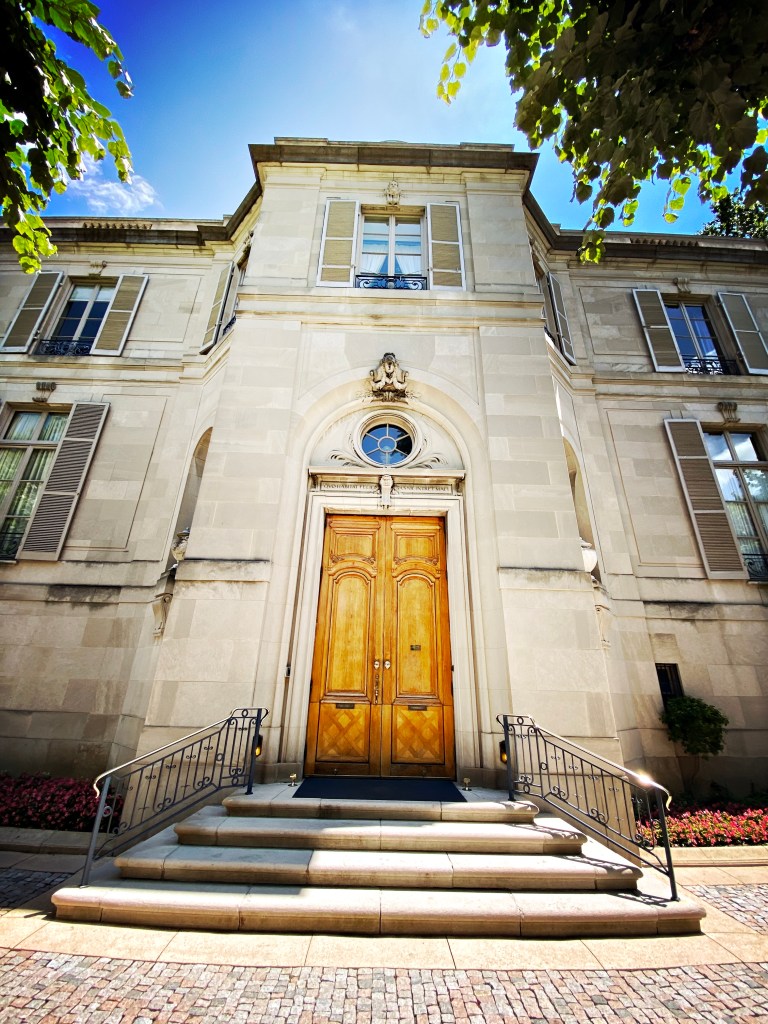
Day 98

Columbia Heights / Park View (September 27, 2020)

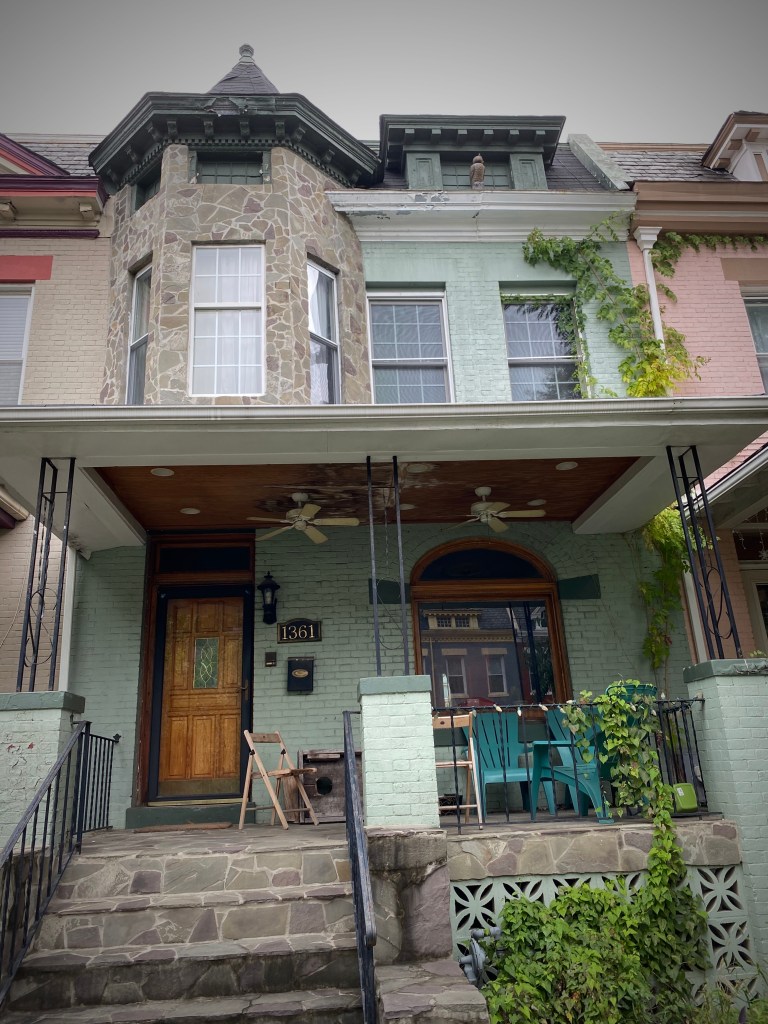
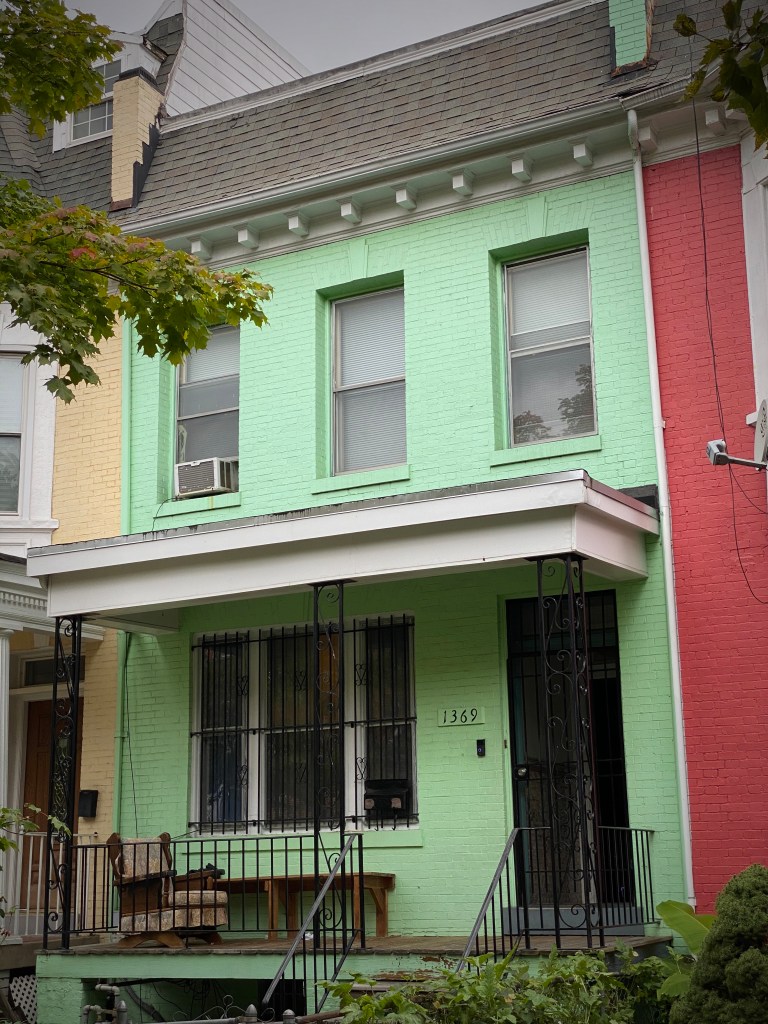
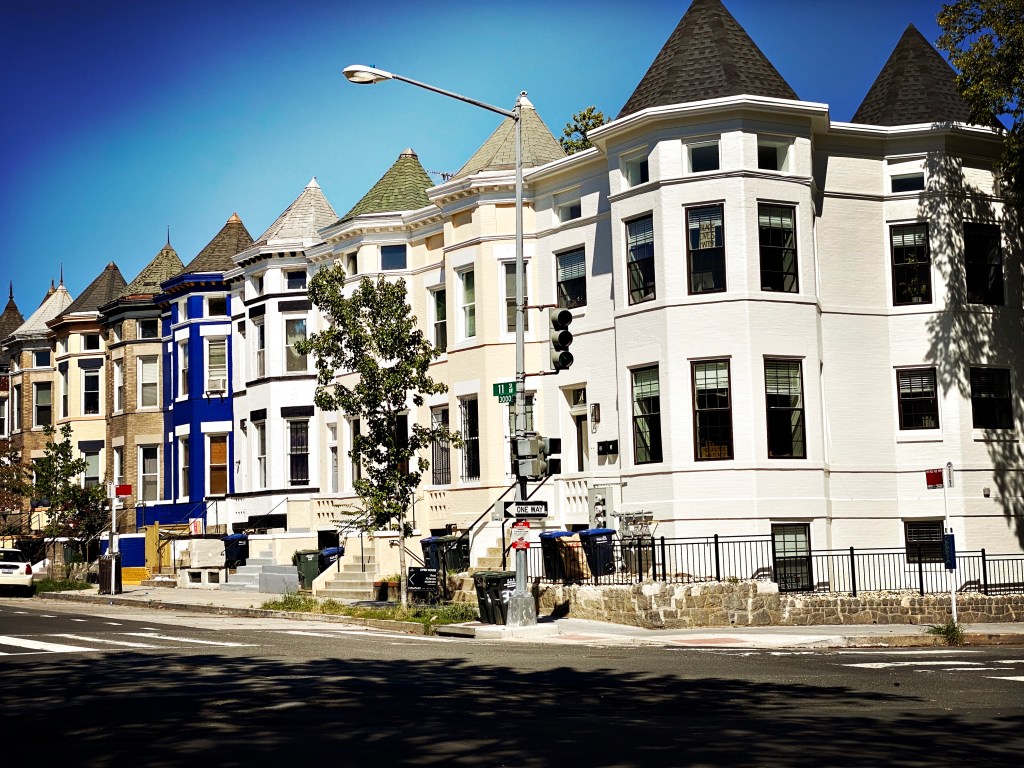
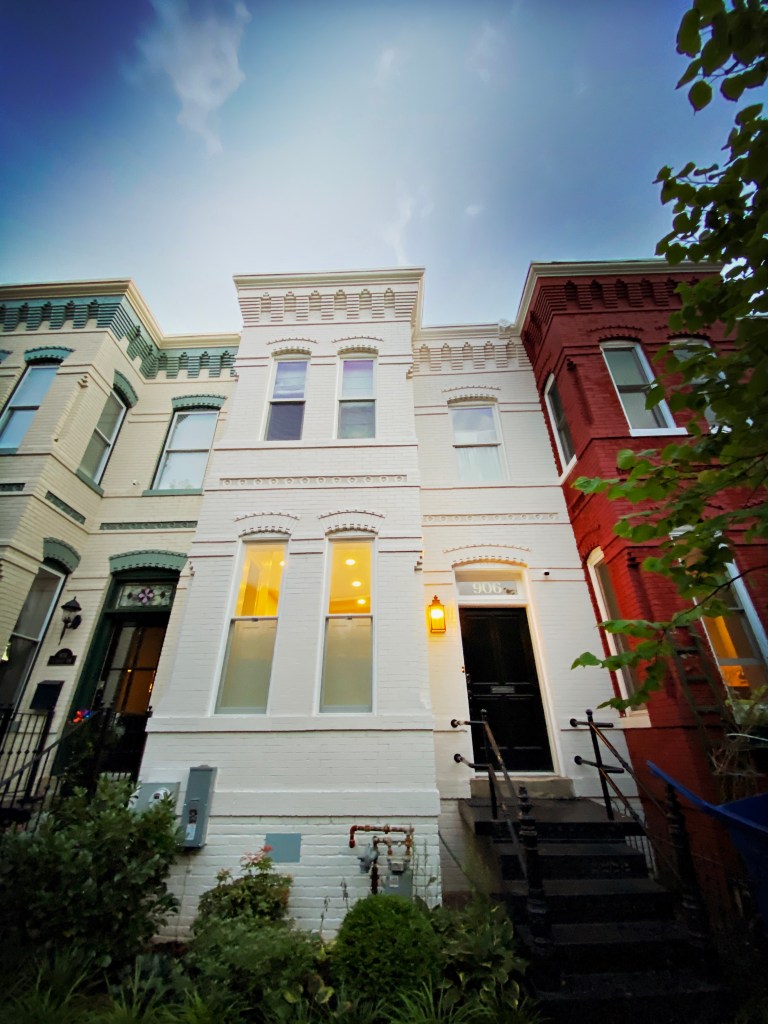
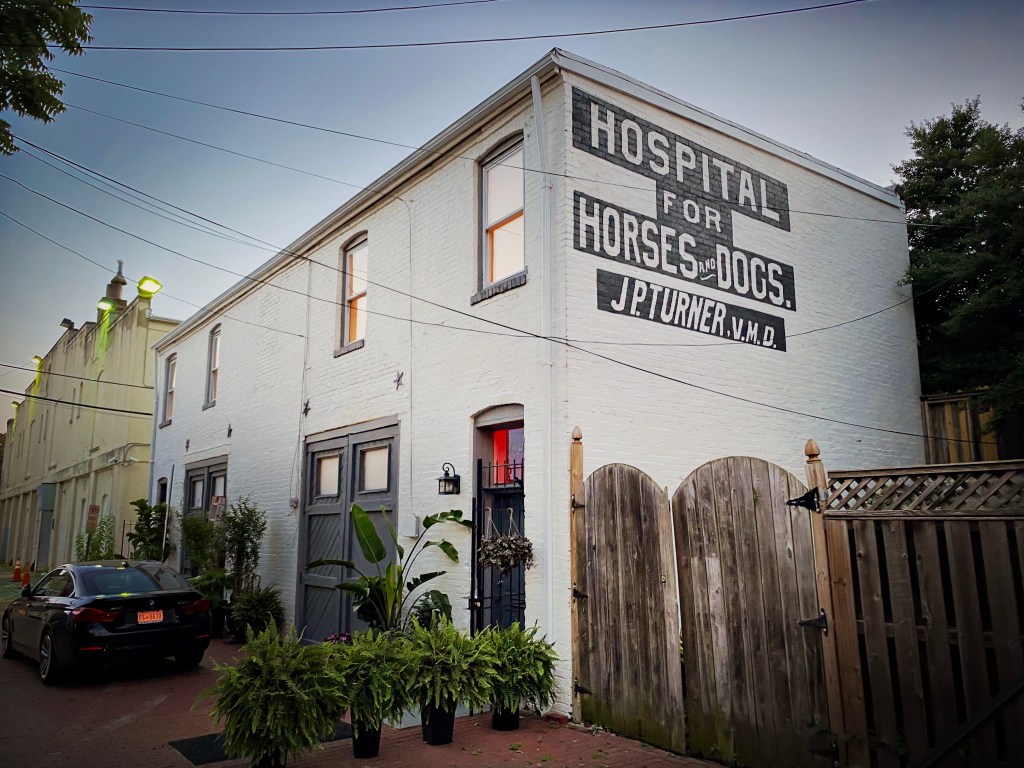
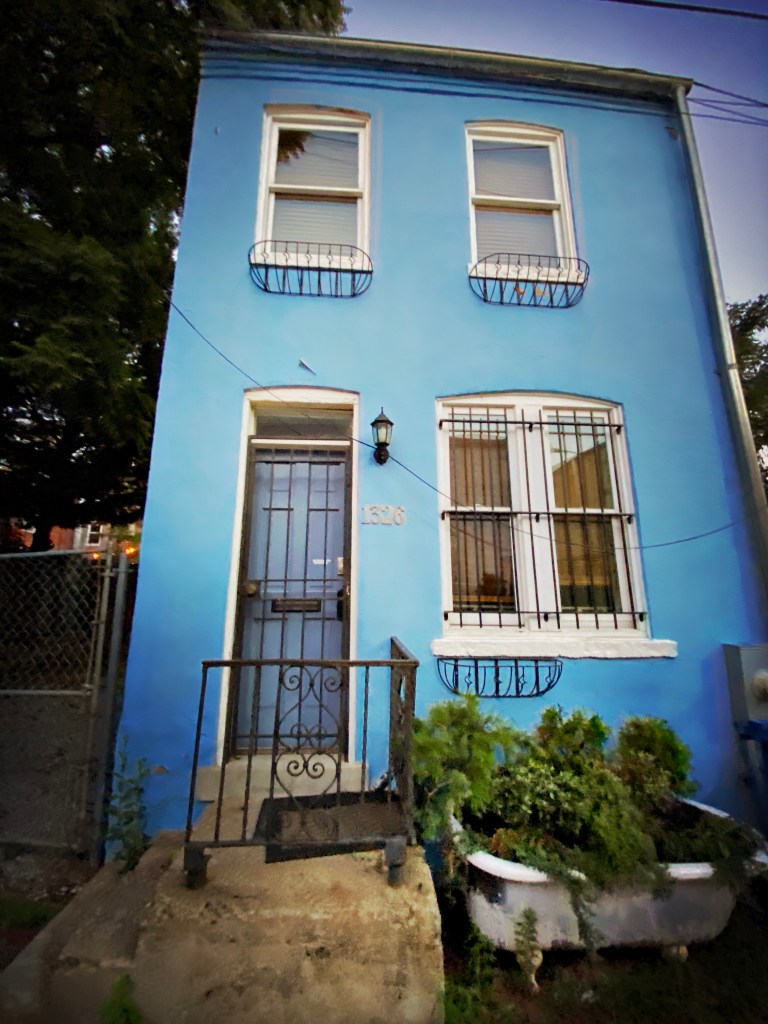
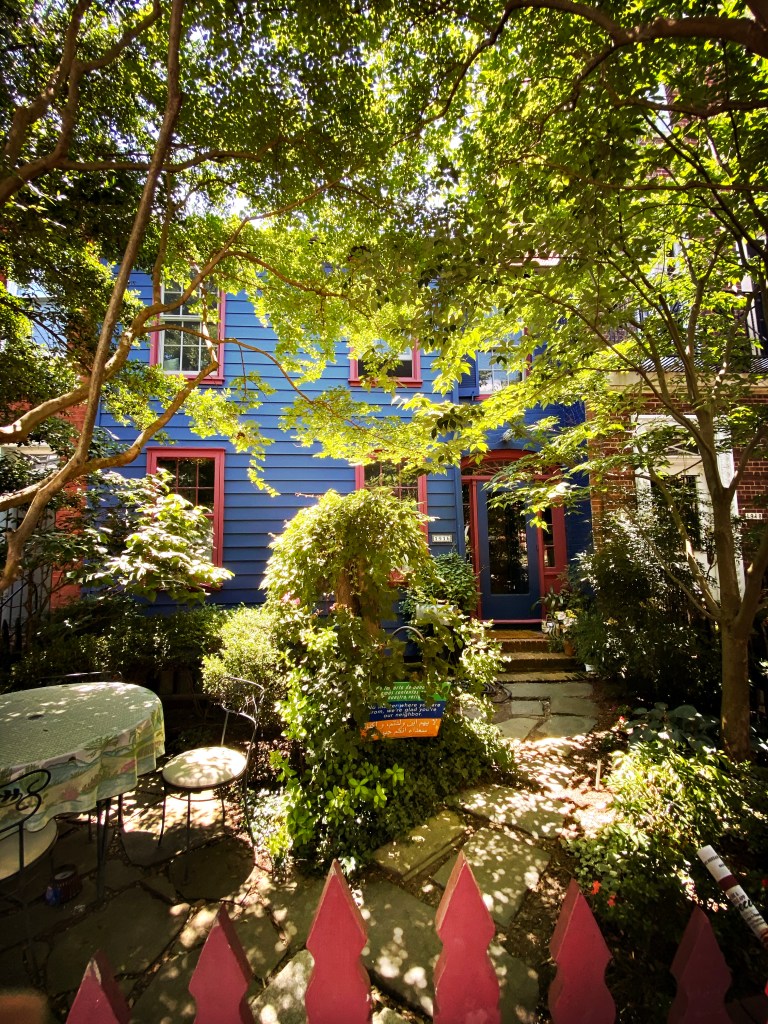
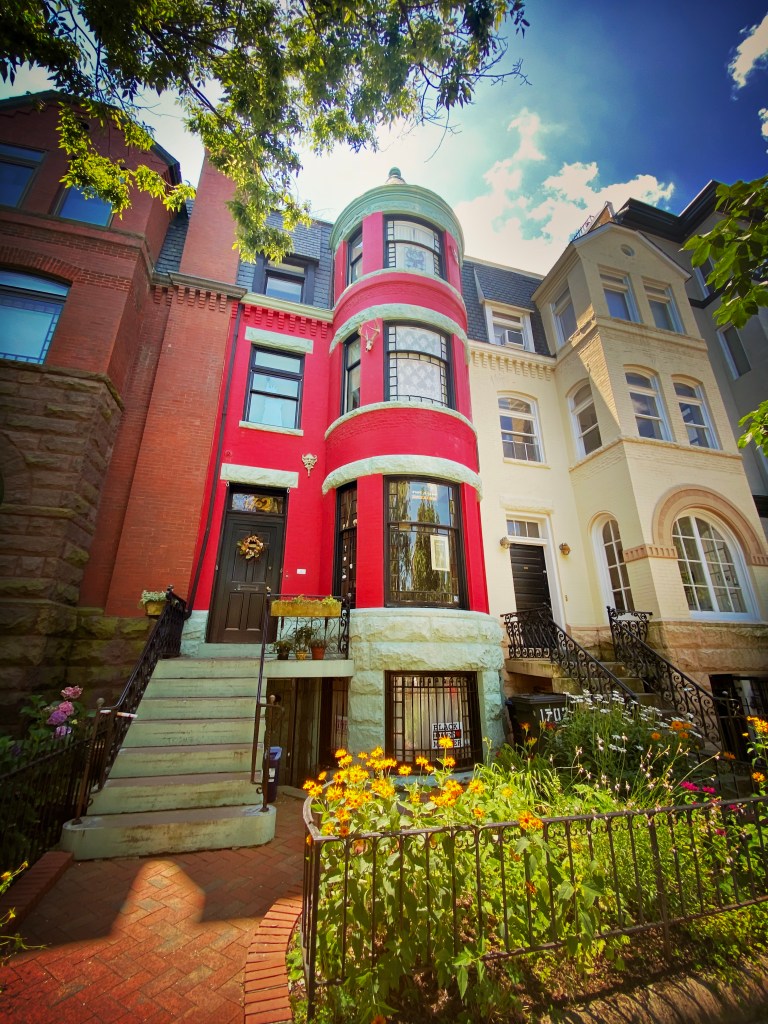
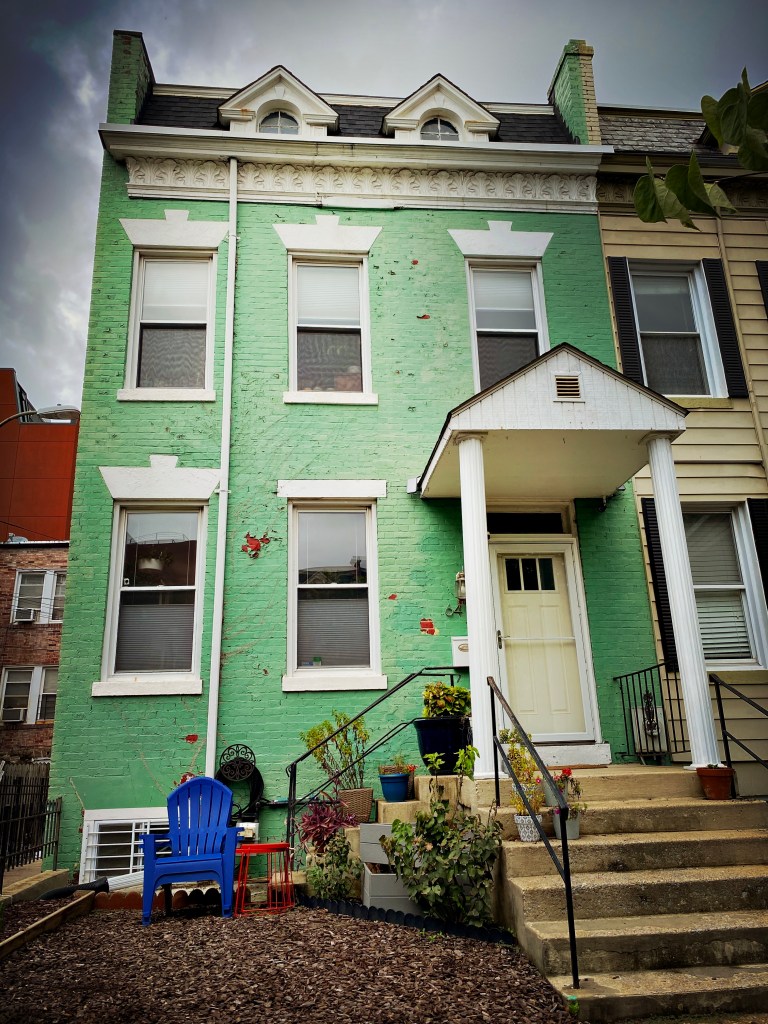
On a grey day, we continued to explore Columbia Heights and neighboring Park View. The two areas are rapidly gentrifying. Consequently a large number of the small apartment buildings and row houses have been recently renovated. Many have been newly painted, often with bright colors. We decided to make green row houses (not eco friendly houses but those actually painted green) our theme of the day.
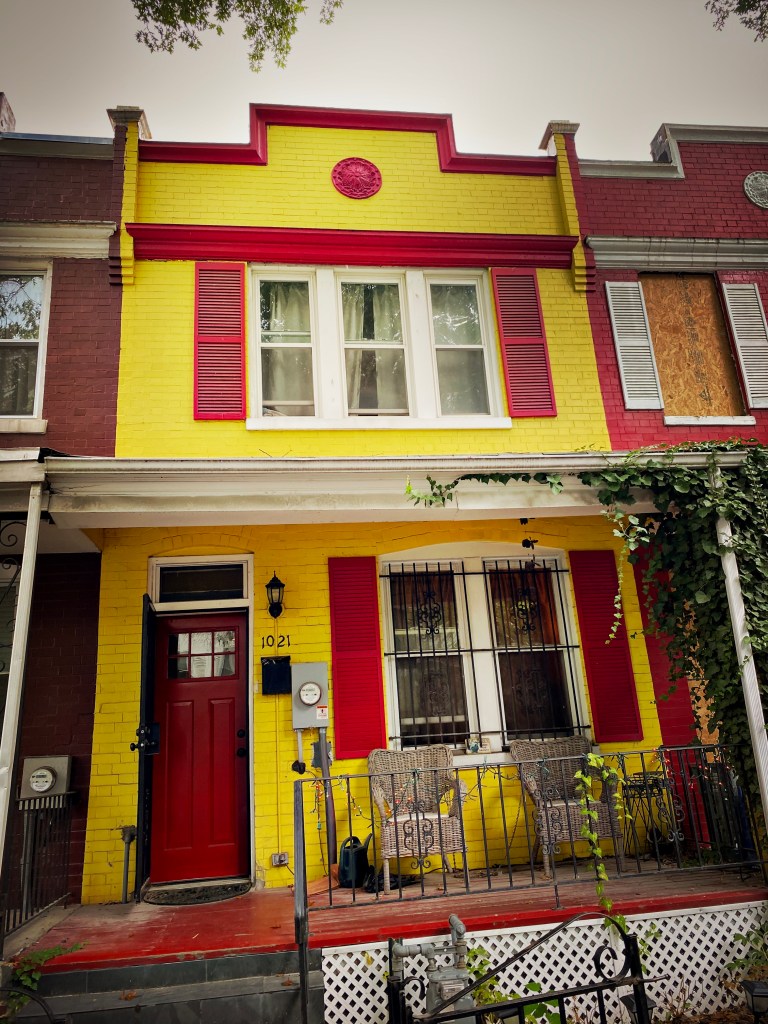
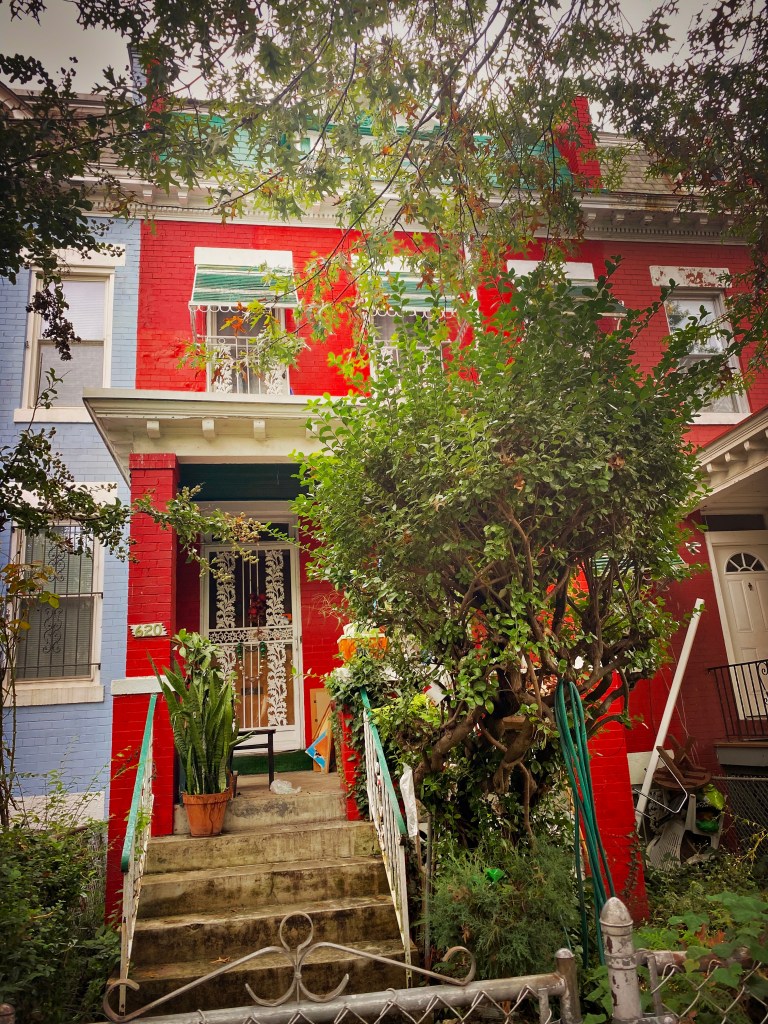
Just for fun, to complete the traffic light, we thought we’d also throw in photos of a yellow as well as a red house.
We don’t often see cats during our walk but we did see a number today, including one on a leash, and this one relaxing by the front door.

We often think of these overcast days as being reminiscent of Europe. We thought that these two, strikingly different, apartment buildings added to the European feel of the day.

Quite often we came across modern buildings tucked in between the original, more traditional, buildings.

With gentrification comes new restaurants, bars, cafes and stores catering to the young professionals moving in to the neighborhood. We dropped in to one for lunch. Tabla is a recently opened Georgian (the country not the state) restaurant that is aptly located on Georgia Avenue. It was our first time eating out during the pandemic.
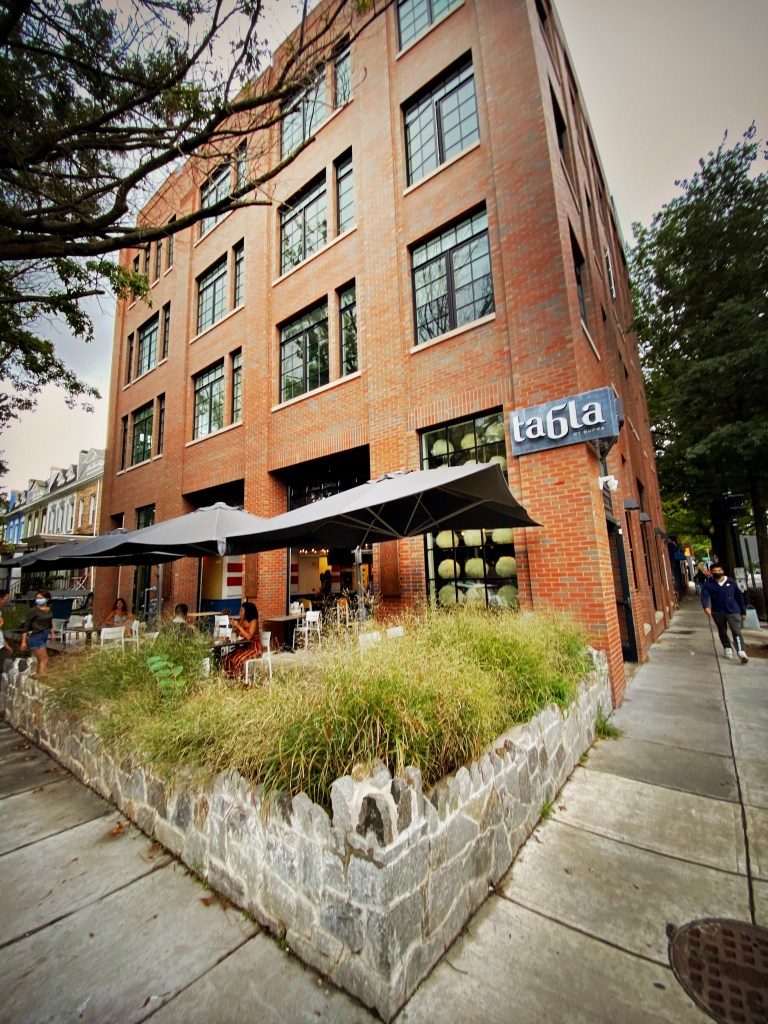
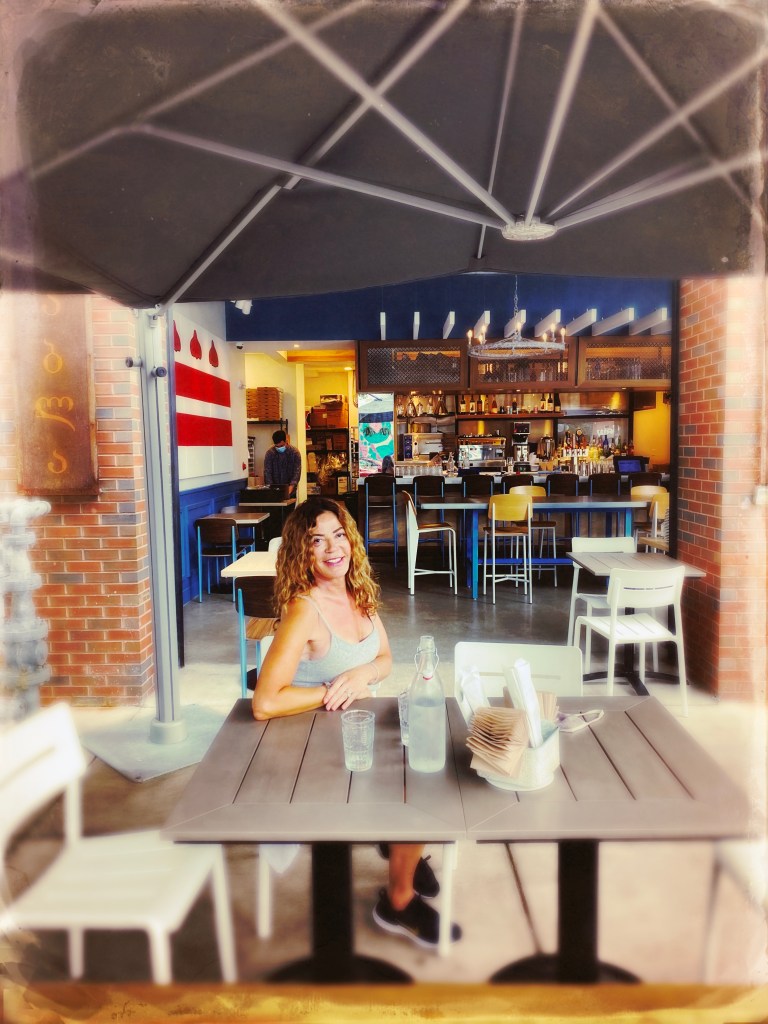
We sat outside on a beautiful terrace and ate chicken kabobs and, perhaps, the best fries that we have ever tasted. We spoke with the owner of the restaurant, Jonathan Nelms, who along with his wife, Laura, also owns Supra, another Georgian restaurant, located in Logan Circle. Jonathan, who is American, worked for a number of years as a lawyer in Moscow. While there he discovered Georgian food, which he told us is the go-to food for many across the old Soviet republics. He compared it to the American love of Mexican food.

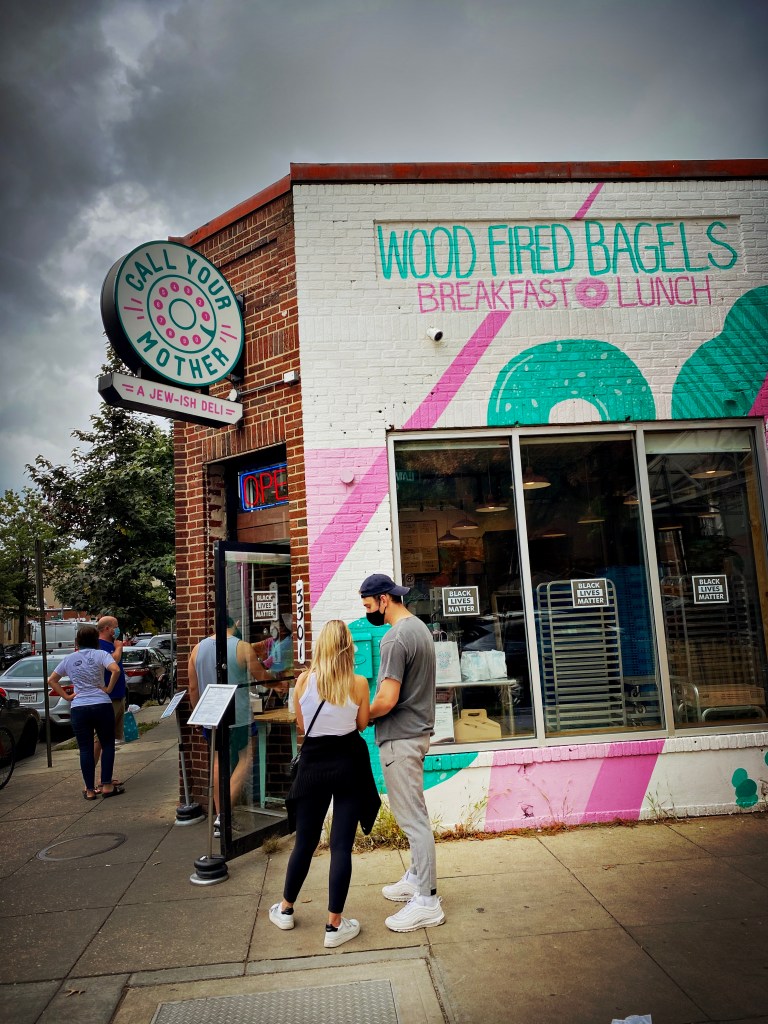
Directly across the road from Tabla is a Jewish deli with the hilarious name of “Call your mother”. It appeared to be doing brisk business with people lined up outside waiting for their orders.
We have often thought during our walks that every neighborhood really should have at least one corner shop.

Odd Provisions is the most upmarket corner market that we have come across so far. Among the items on display were an assortment of craft beers, fancy cheeses, olive oils, and locally sourced vegetables.

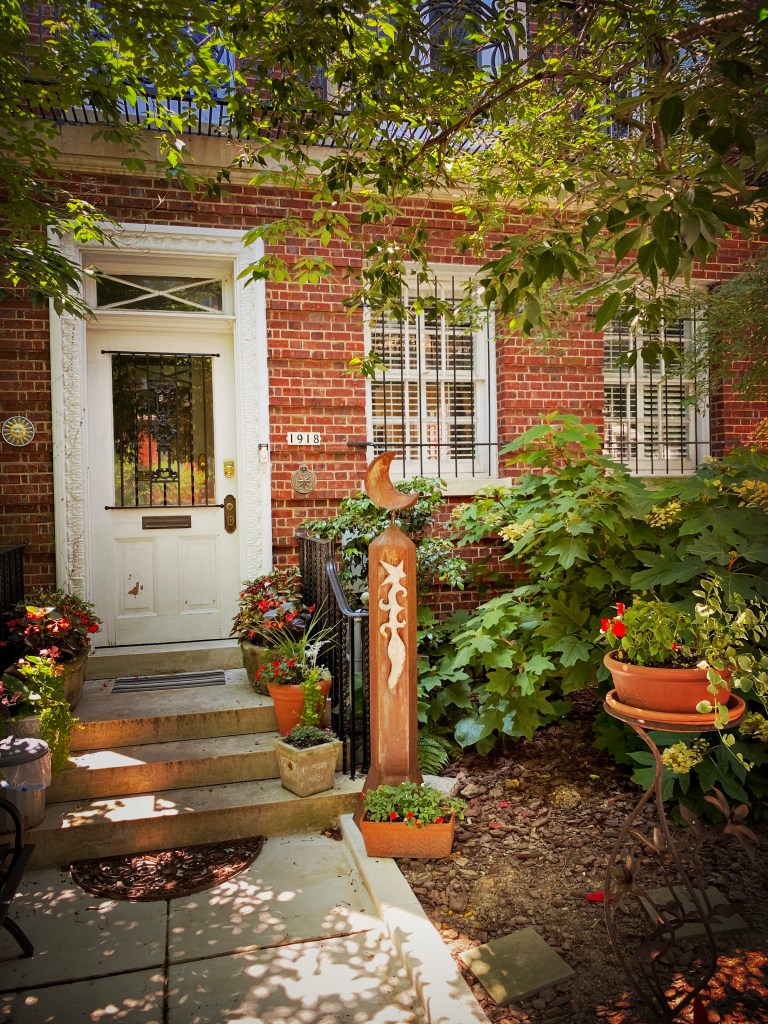
We liked the way that the residents of these two row houses appeared to have coordinated their curb appeal. They shared a front yard, street lamp and even “No Justice No Peace” sign.

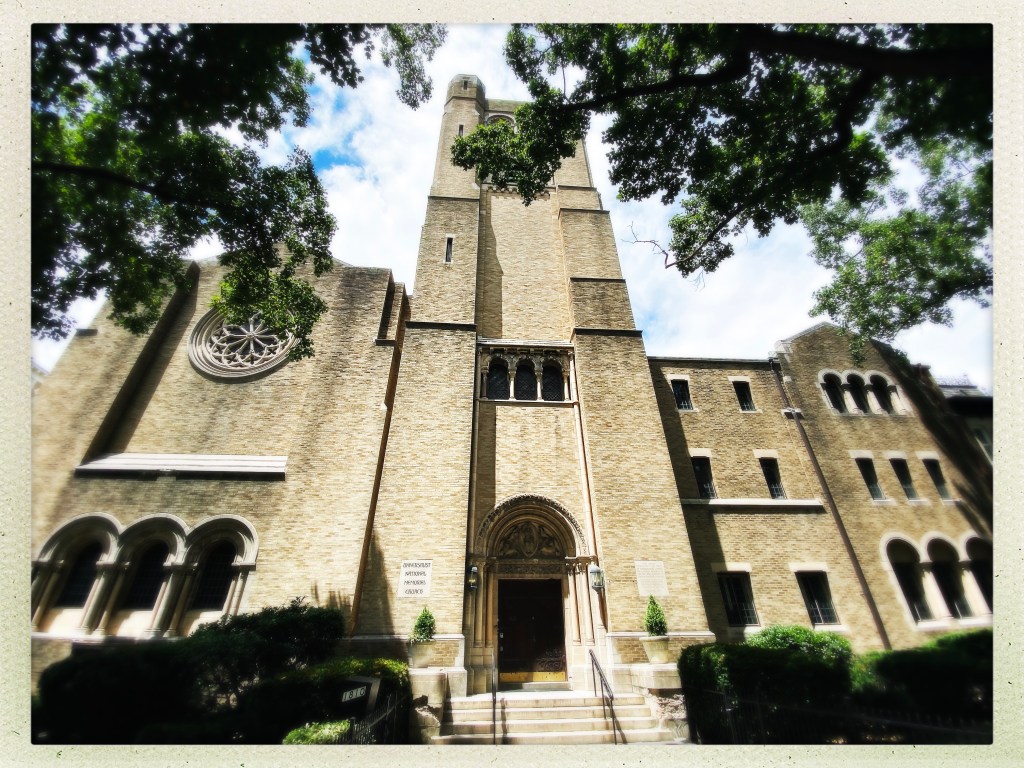
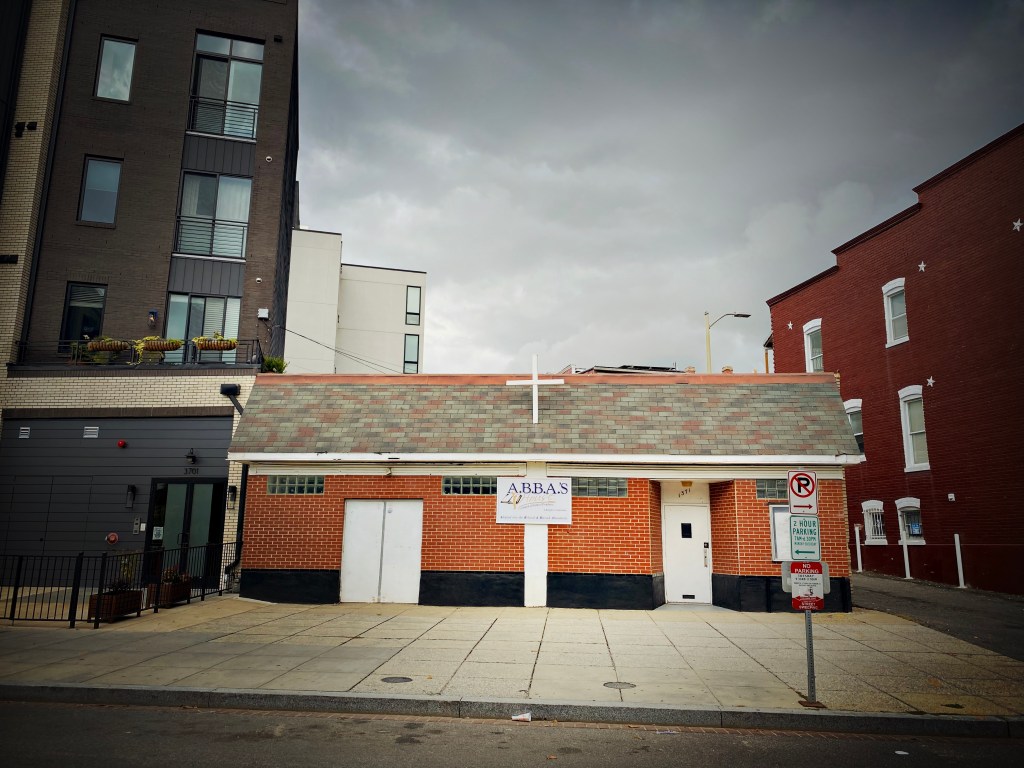
The churches scattered throughout the neighborhood didn’t have the same grandeur as those we had seen lining 16th Street.

On Spring Street we passed a beautiful old building that was being renovated. It was adorned with a number of Stars of David which piqued our interest as to its history. Lauren’s guess that it had probably been a Jewish old age home or hospital turned out to be correct.

The building was originally built for the Hebrew Home for the Aged, which occupied the building from 1925 through 1969. As jews moved out of the area and into the suburbs, the Home followed and was relocated to Rockville Maryland. The building was sold to the District of Columbia in 1968 for $13 million. Originally the building was used by the District as a homeless shelter. However, the shelter closed in 2009 and the building has stood empty from that time. But now the District is renovating the building into senior living and residential facilities.
Day 97

Columbia Heights (September 20, 2020)

Back in Columbia Heights today, on what was the nicest walking weather, so far, this year. There was definitely a touch of Fall in the air.

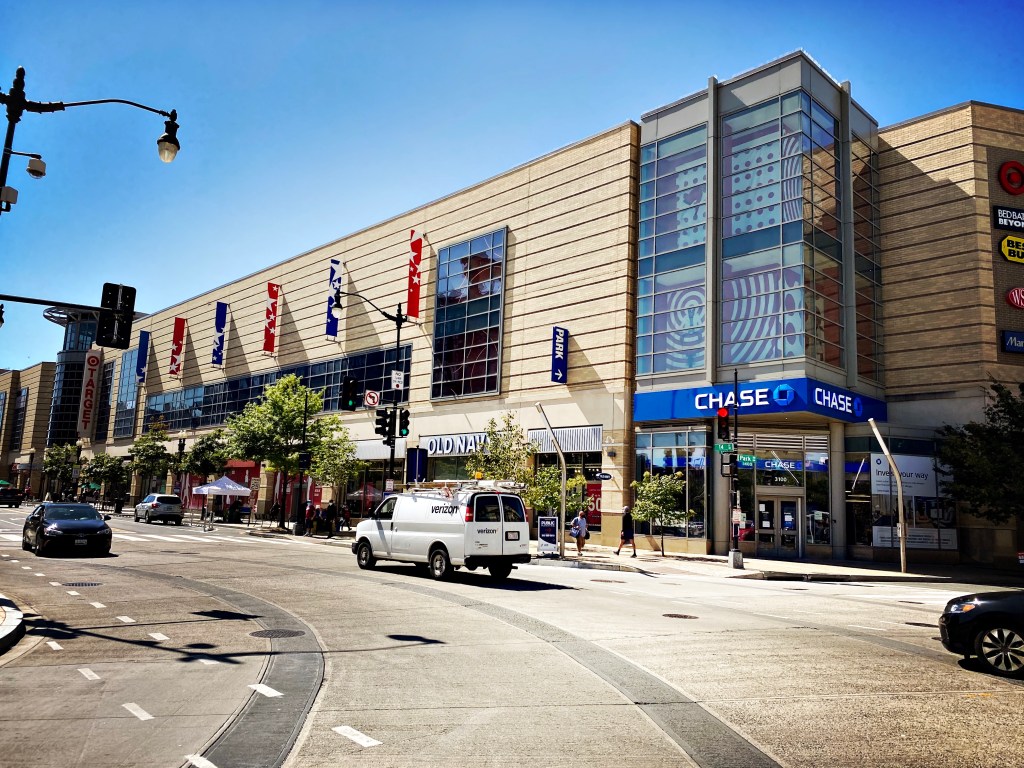
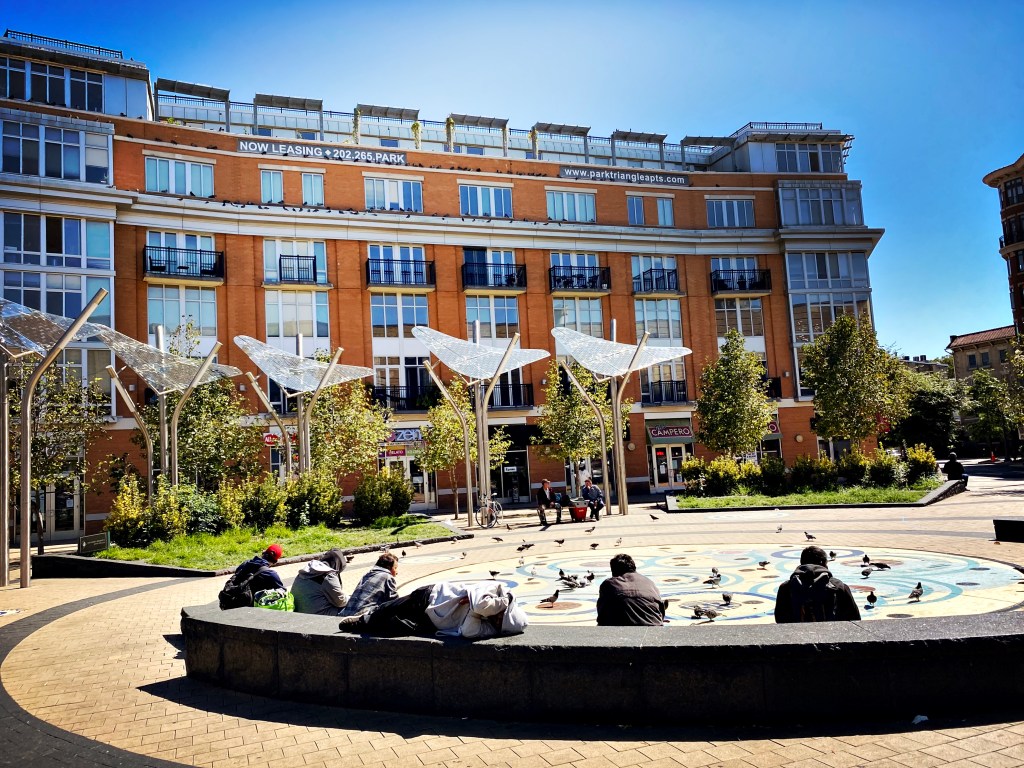
We started off at the center of Columbia Heights where Park Road NW meets 14th St. NW. This area was redeveloped a few years back not without controversy. Many felt that the large shopping mall and apartment buildings detracted from the original charm of the neighborhood. We can’t say we disagree.

However, one important historic building was kept.

The Tivoli Theatre was designed by prominent New York architect, Thomas W. Lamb who designed many famous movie theaters during the 1910s and 1920s. The Tivoli was built in 1924 for a cost of $1 million and showed movies through to 1976 when it was closed due to increased deterioration of the theater and the local area. However, as the area revitalized, the Tivoli undertook an extensive renovation and reopened in 2005. It is now the home of GALA (Grupo de Artistas Latino Armericans) Hispanic Theater.

The area consists mainly of row houses and small apartment buildings.

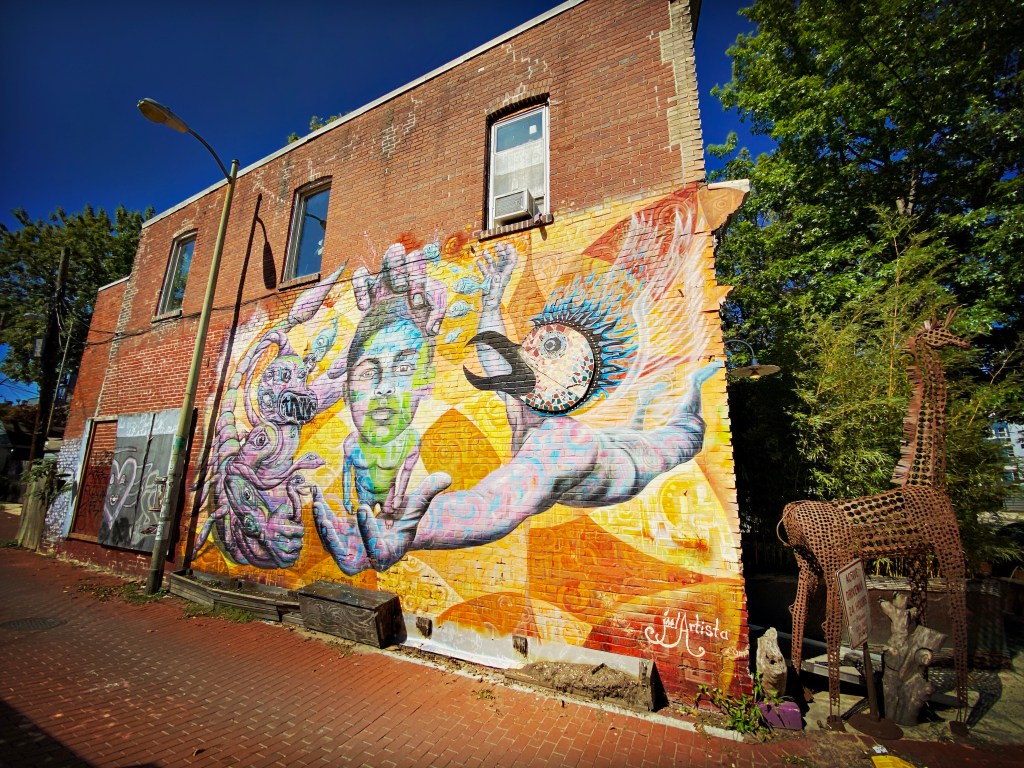
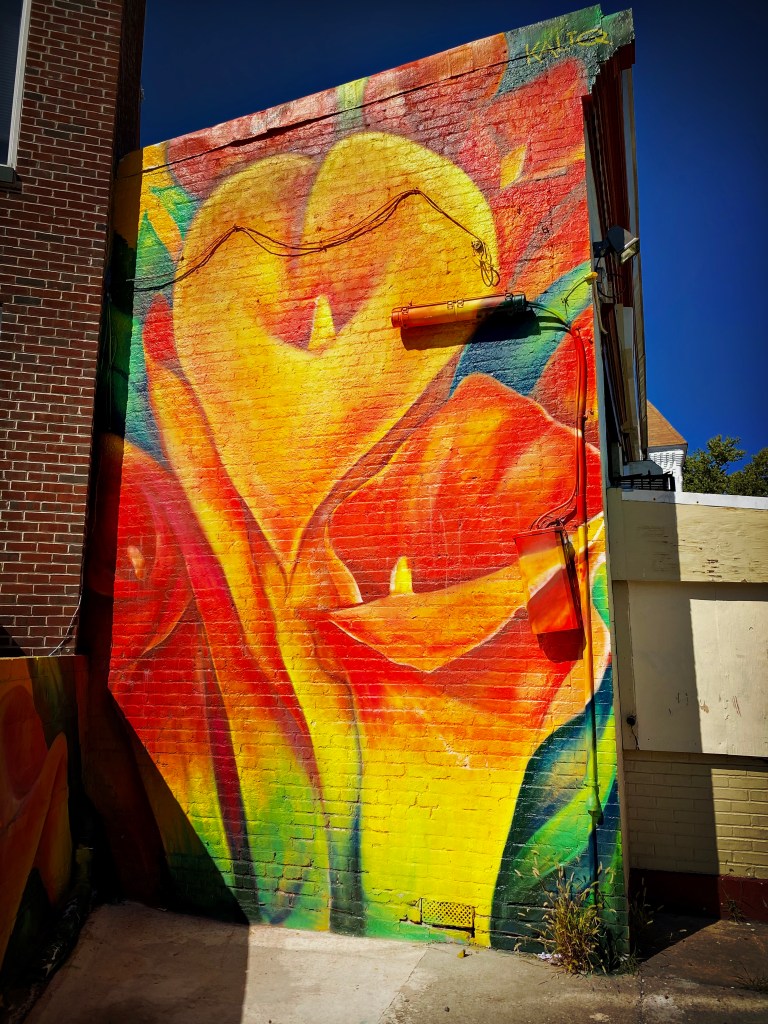
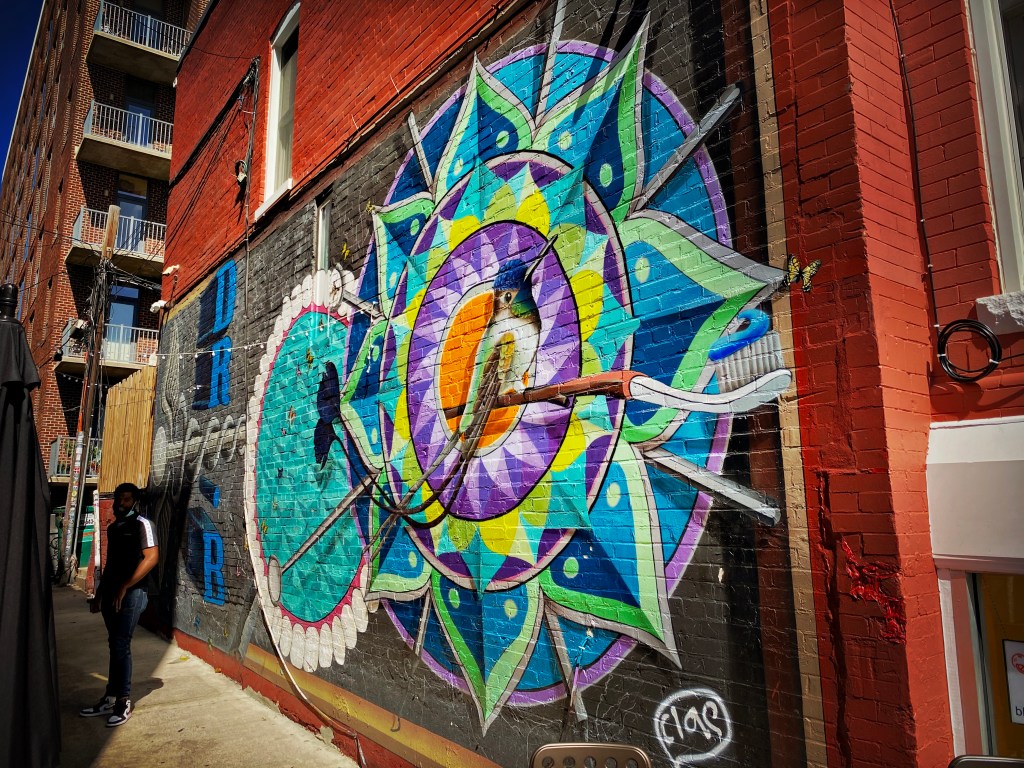
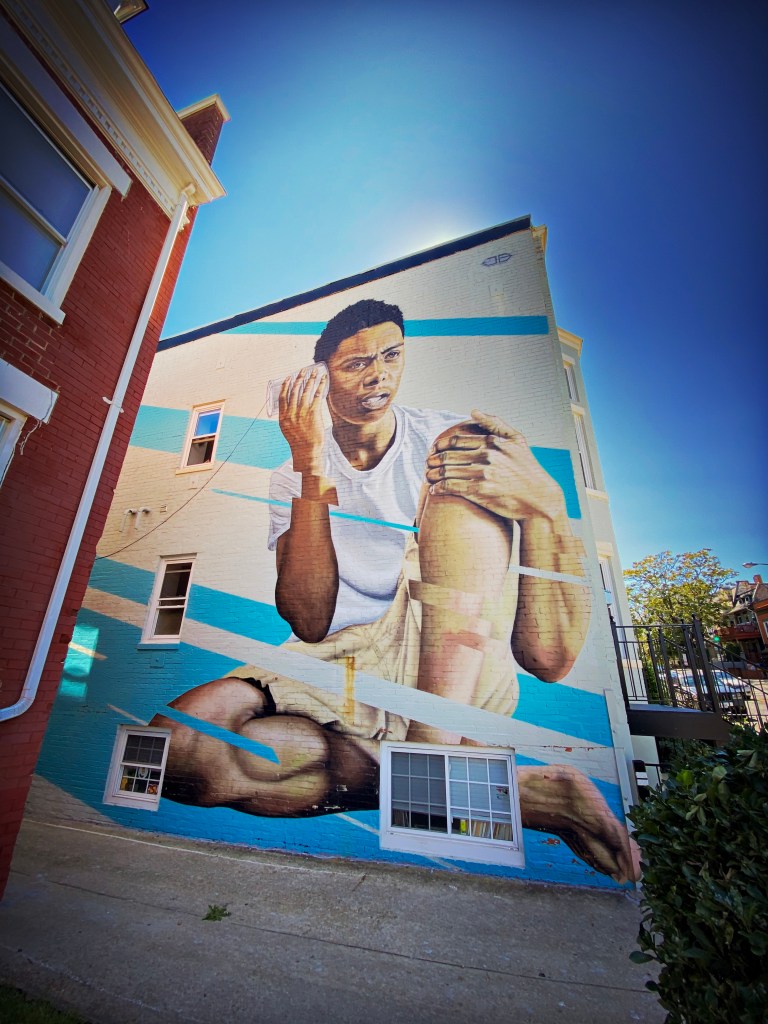
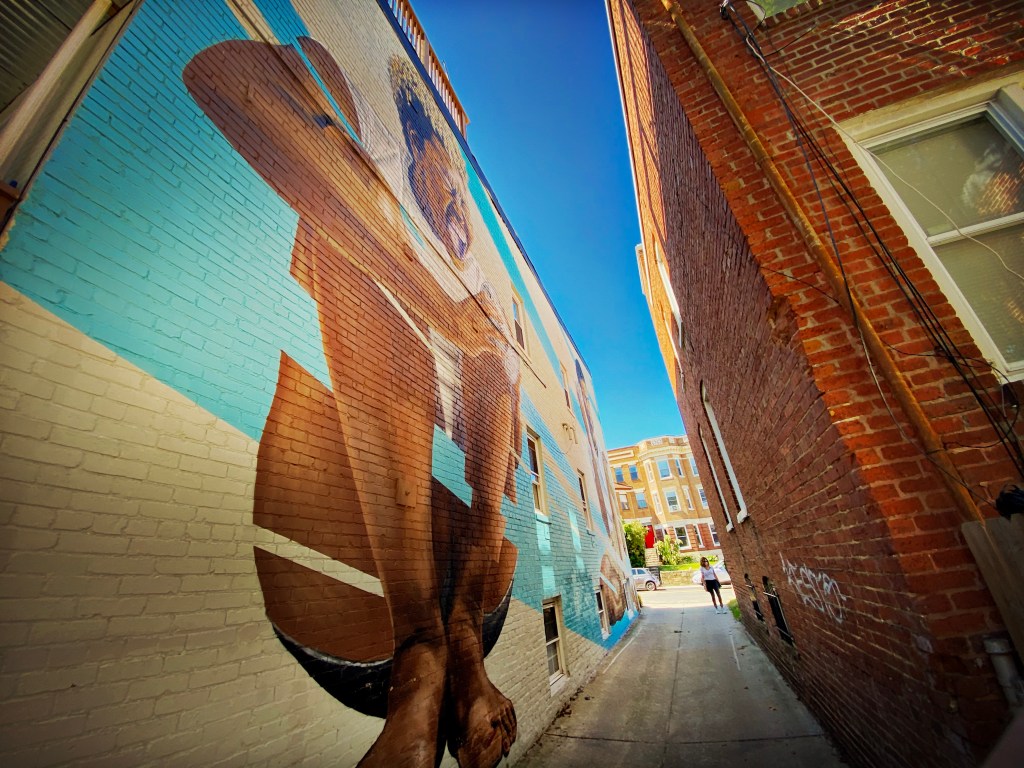
We passed a number of colorful and interesting murals during our walk.

Our favorite was this mural painted along the side of a row house that depicted two people talking by way of cans connected with string.

One Washington Institution with its own awesome mural is Ben’s Chili Bowl.

Ben’s, located on U Street, has been selling chili dogs, half-smokes and milkshakes, along with other tasty (but not altogether healthy) food and drinks since 1958. Over the years, it has attracted many famous people. Jazz legends Duke Ellington, Miles Davis and Nat King Cole frequented Ben’s when they played at the numerous clubs that lined U Street in the fifties and sixties. More recently, President Barack Obama, U2 frontman Bono and celebrity chef Anthony Bourdain have all dropped by. Perhaps its most adoring customer was Bill Cosby who was a big fan of the half-smokes. For those not in the know, a half-smoke is a Washington DC delicacy. It is similar to a hot dog but larger, spicier, and with more coarsely-ground meat (often half-pork and half-beef) smoked and serve with herbs, onion, and chili sauce. There used to be large mural featuring Bill Crosby adorning the building but it was removed in January 2017 after he was convicted of numerous sexual assaults. Today the Obamas and Prince take pride of place on the mural.
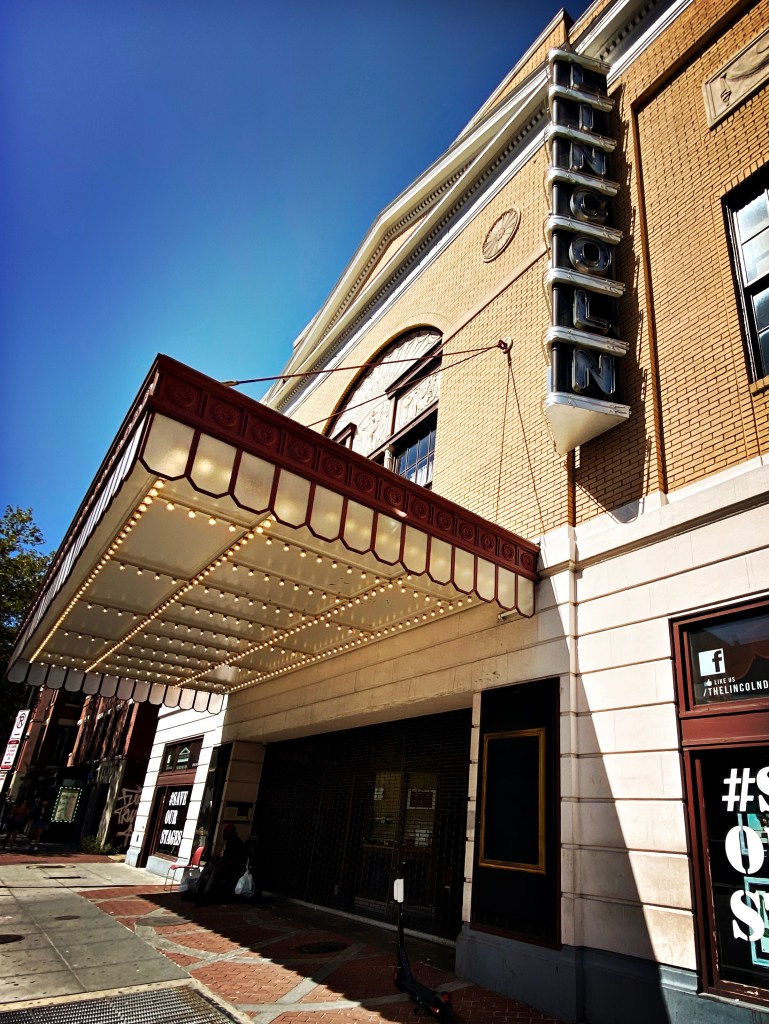
Next door to Ben’s is the Lincoln Theater. The theater served the city’s African American community when segregation kept them out of other venues. It included a movie house and ballroom and hosted jazz and big band performances. It closed after the 1968 race-related riots that devastated that part of the city. The theatre reopened after an extensive renovation in 1994. It is now operated by the same company that owns the iconic 9:30 Club that is nearby and has booked hundreds of shows of artists from across the musical spectrum. Everyone from Kendrick Lamar to Peter Frampton has played there.

We walked by a restaurant that is less famous than Ben’s but is incredibly popular with area foodies.
Bad Saint is a tiny Filipino restaurant that is consistently ranked in the top ten dining destinations in the District. With only twenty seats it was virtually impossible to get into. In fact, at the moment its truly impossible because the dining room is closed due to the pandemic. However, it continues to offer carryout, so if you want to see what all the fuss is about check out their website at badsaintdc.com to find out how to order.

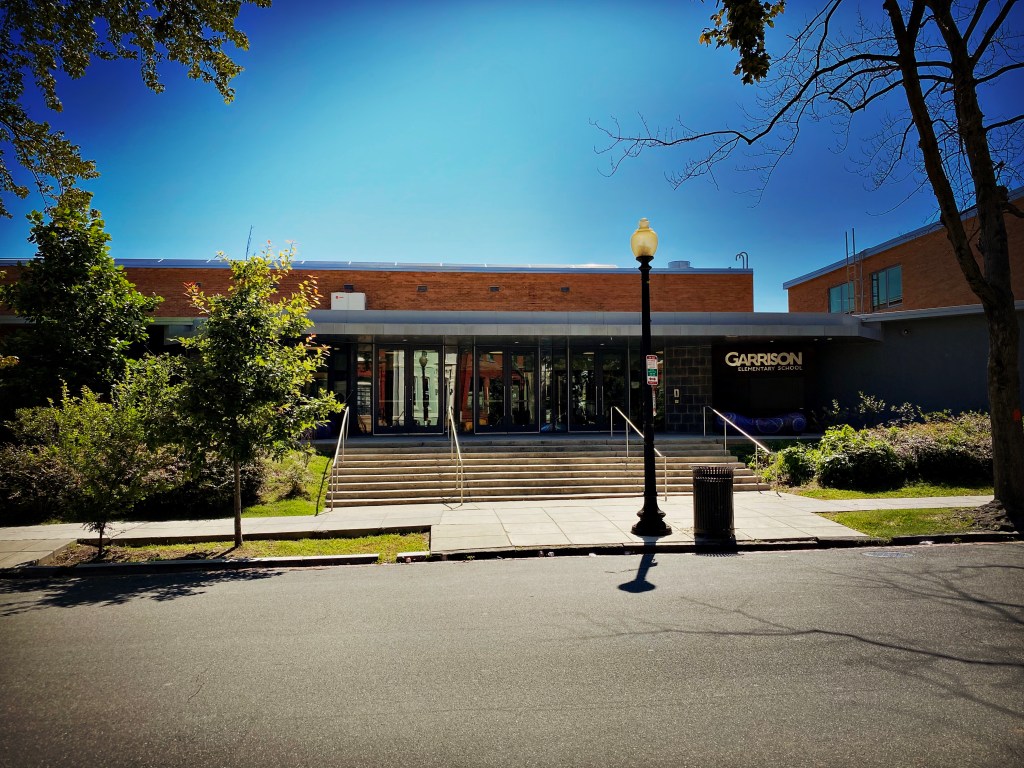
We walked by a number of schools, including Harriet Tubman and Garrison elementary schools.

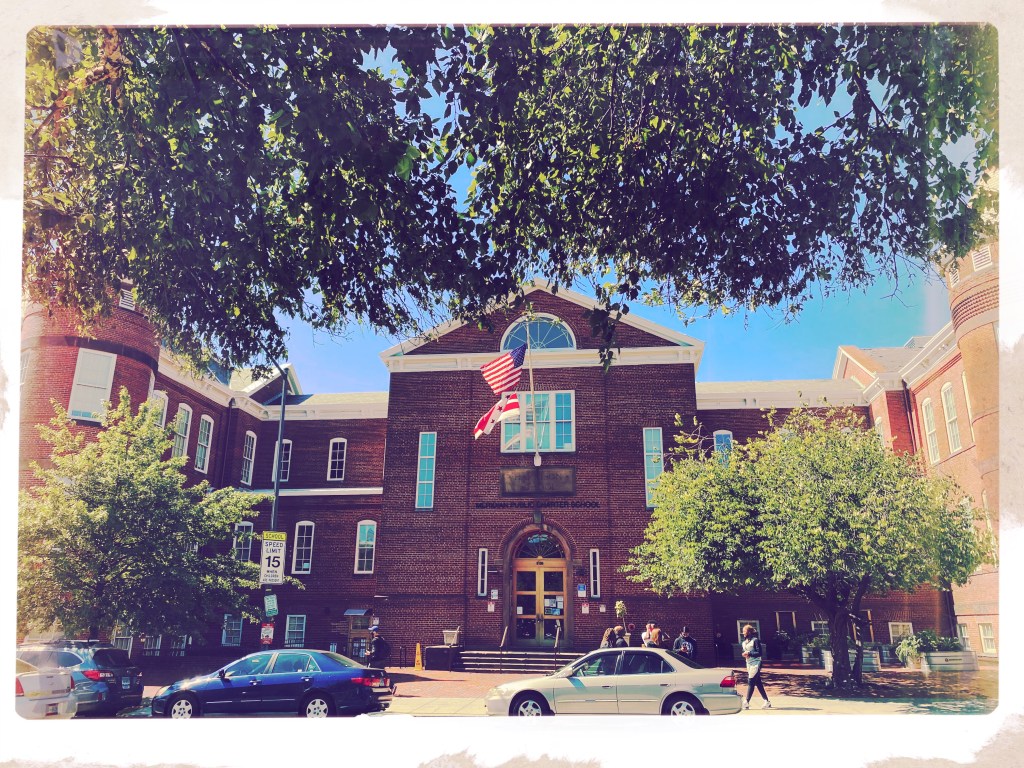
As well as Meridian Public Charter School.

However, by far the most impressive school we passed was the Francis L. Cardozo Education Campus. Formerly called Cardozo Senior High School and Central High School, it is a combined middle and high school. It is named after Francis Lewis Cardozo, a clergyman, politician and educator. Born in 1836 in Charleston, South Carolina, Cardozo was the son of a biracial mother and sephardic Jewish father. He was elected Secretary of State in South Carolina in 1868, and as such was the first African American to hold statewide office in the United States. He also served as principal of nearby Dunbar High School, then known as the Colored Preparatory High School from 1884 until 1896.

Know locally as “the castle on the hill”, the formidable building was designed by William B. Itner and opened in 1917. From 2011 through 2013, the school underwent extensive renovations costing approximately $130 million.

Day 96

Hains Point (September 17, 2020)

On an overcast day, we decided to do a somewhat different walk from the usual urban streets we hike, and headed down to Hains Point. Despite its name, Hains Point is not so much a point as an island, bounded by the Tidal Basin, the Washington Channel and the Potomac River. An artificial island built between 1880 and 1892, the island is named for Peter Conover Hains (1840-1921), a Major General in the United States Army. Although he served in the Army during the American Civil War, Spanish-American War and the First World War, Hains is best known for his engineering efforts. Among other projects, he designed the Tidal Basin which sits at the northwestern end of the Point and lobbied for the Panama Canal to be located at its present location rather than in Nicaragua.

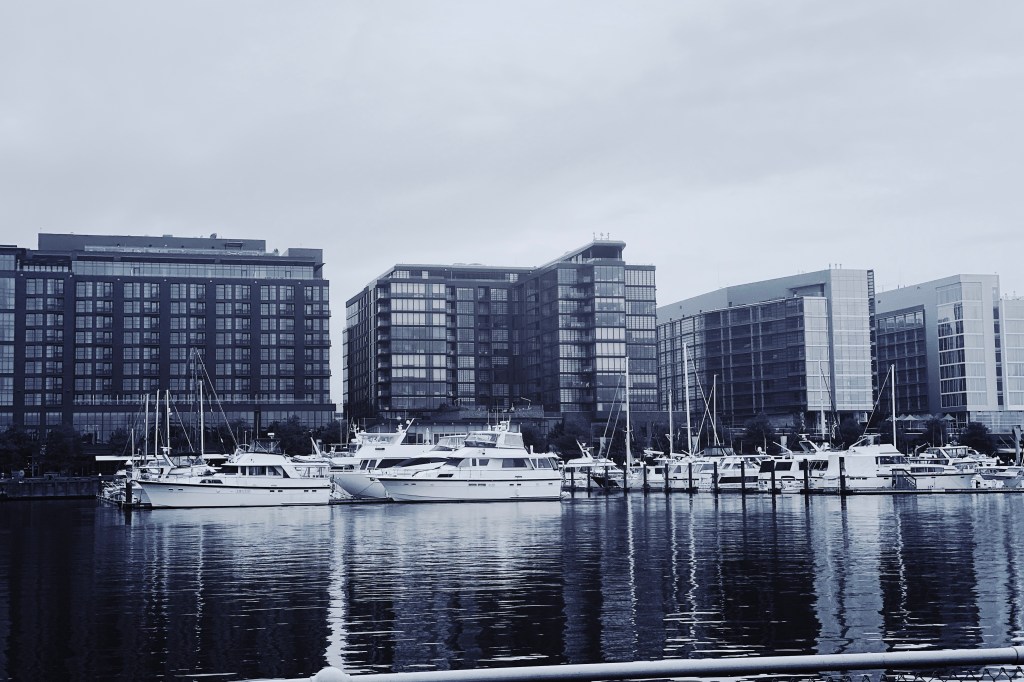
We started our walk on the channel side of the island. Across the narrow channel is the newly constructed Wharf neighborhood.

This wildly popular area of apartments, bars, restaurants and music venues continues to expand as more and more buildings are being constructed along the channel.

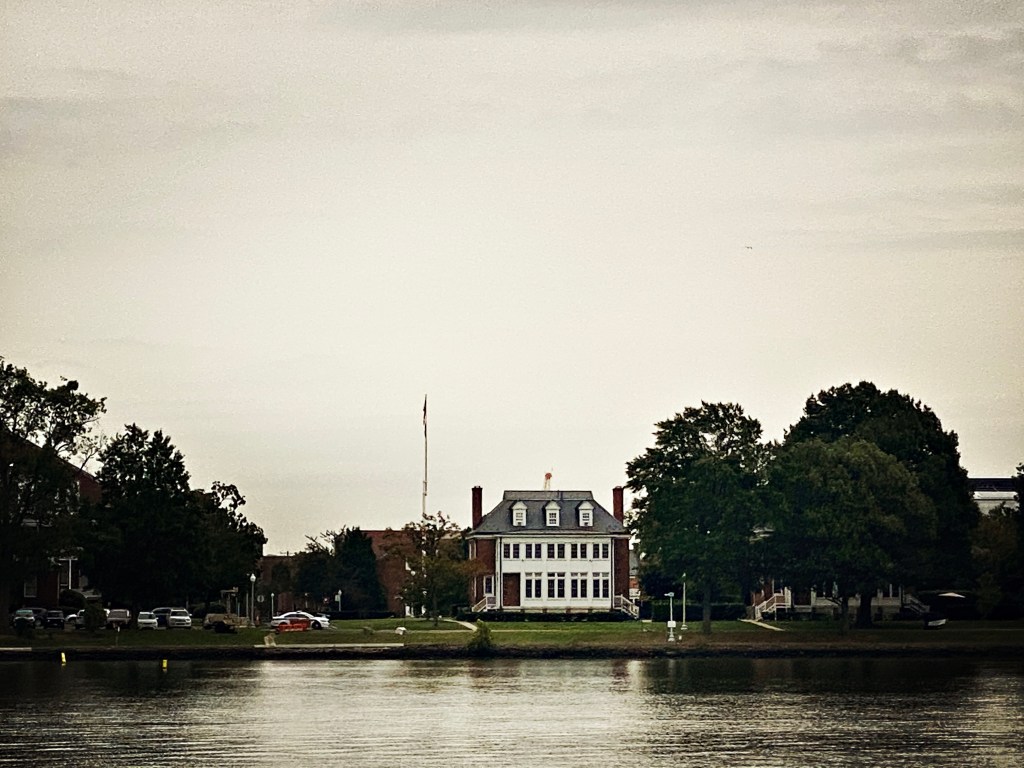
Further along the channel toward the point where the channel, Anacostia River and Potomac River all converge is Fort Leslie J. McNair. The fort, named for a general killed in action in World War II, is one of the oldest forts in the United States. It was first established in 1791 but was captured and destroyed by the British during the War of 1812. It was subsequently rebuilt between 1815 and 1821. The conspirators accused of assassinating president Abraham Lincoln were imprisoned and tried at the Fort and a number were hanged there. Those included Mary Surratt, the first woman to be executed by the US Federal government.

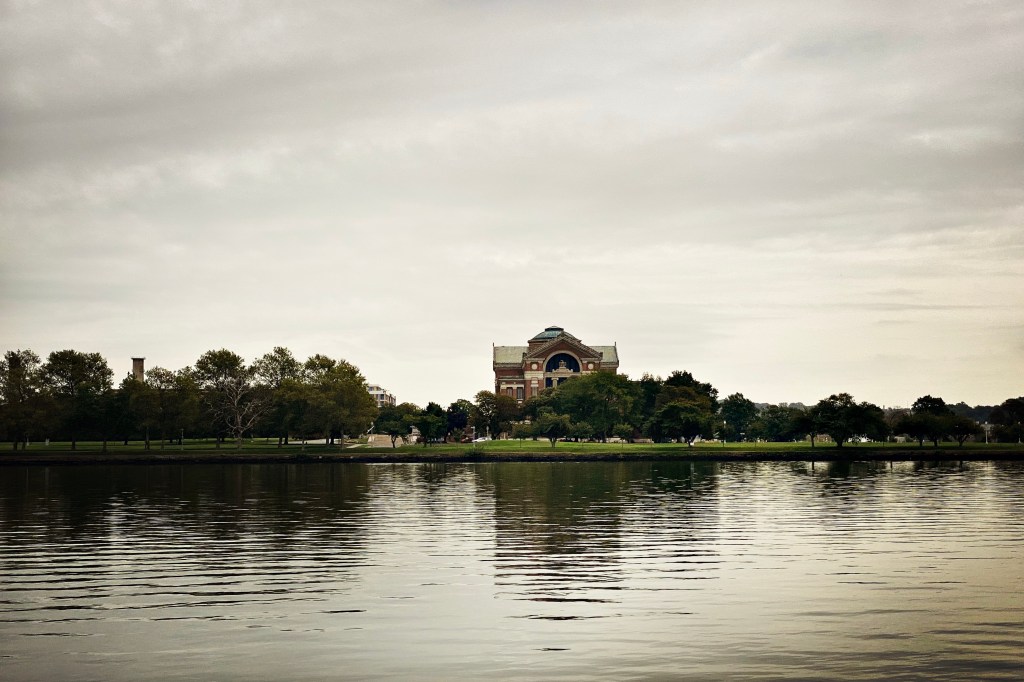
The Fort contains, Roosevelt Hall, an immense Beaux Arts style building built between 1903 and 1907. It currently houses the National War College and is designated as a National Historical Landmark.

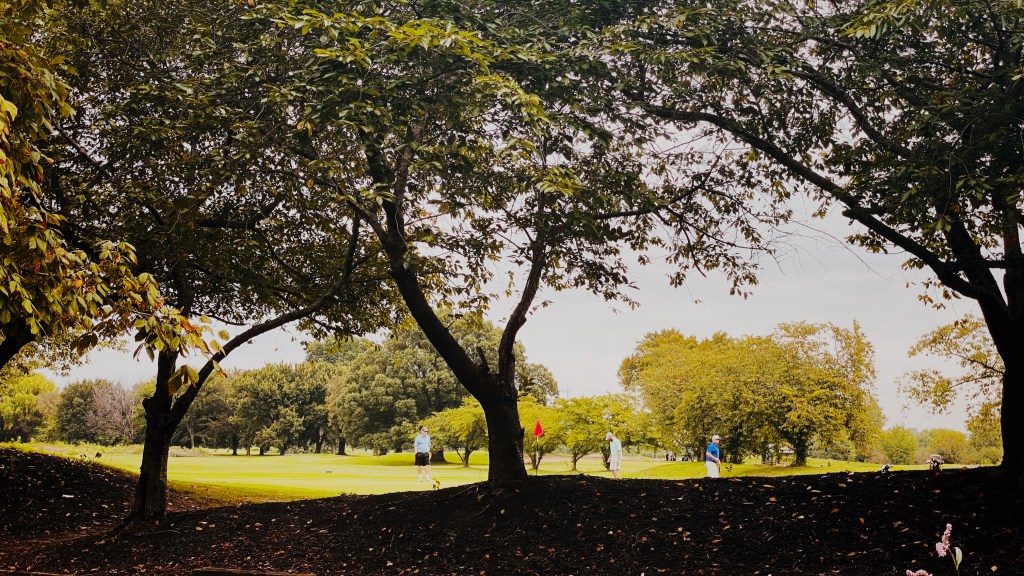
A large part of Hains Point consists of the East Potomac Golf Club which offers an 18 hole and two 9 hole courses. The courses are very popular public courses and appeared to be in full use as we passed. Mal, who truth be told isn’t much of a golfer, has enjoyed some of his most memorable games there when he and some colleagues would occasionally sneak away from work for a quick round. The club house is quite impressive for a public course.

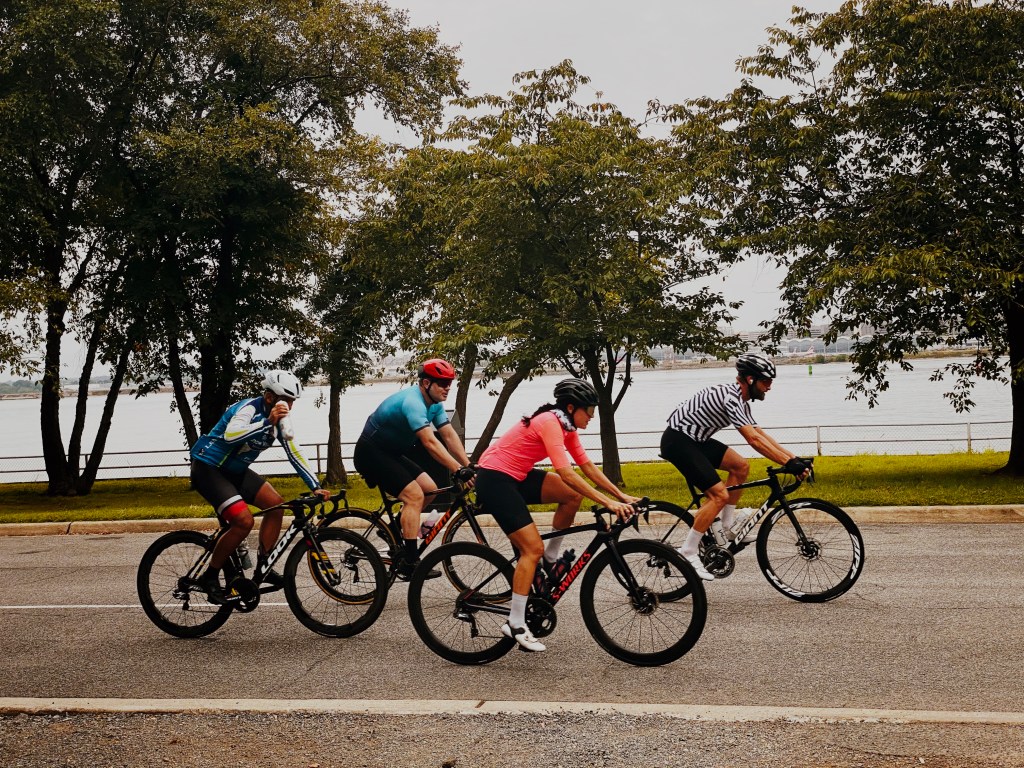
The point is also a favorite with cyclists who take advantage of the largely traffic free road that encircles the island.

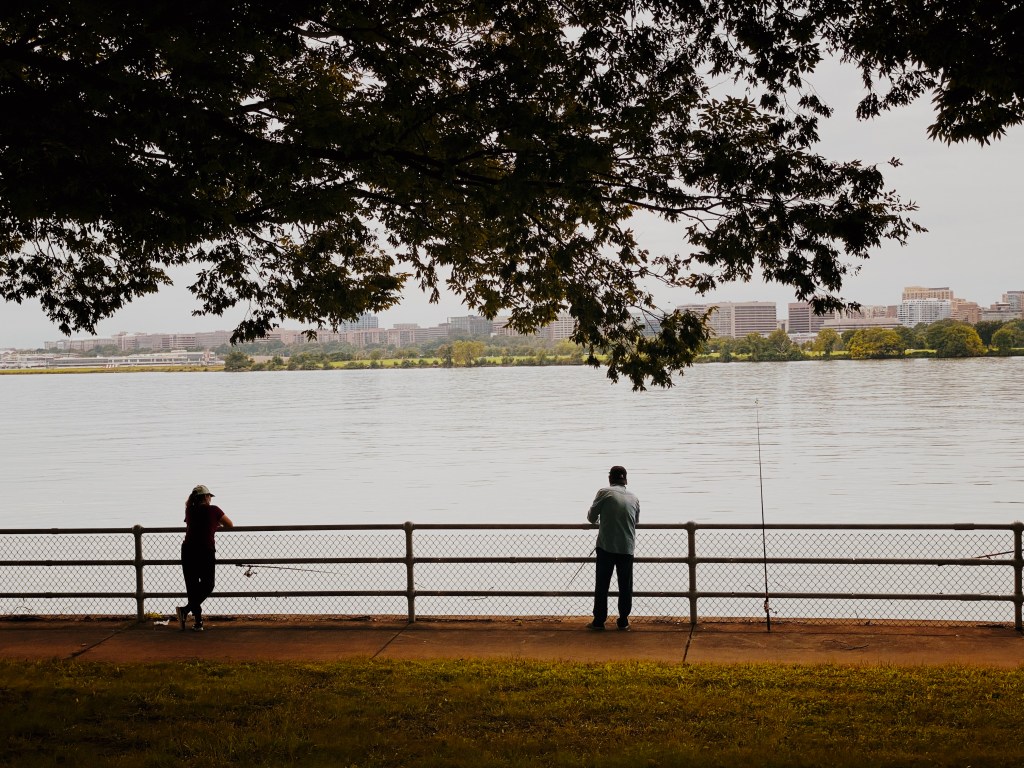
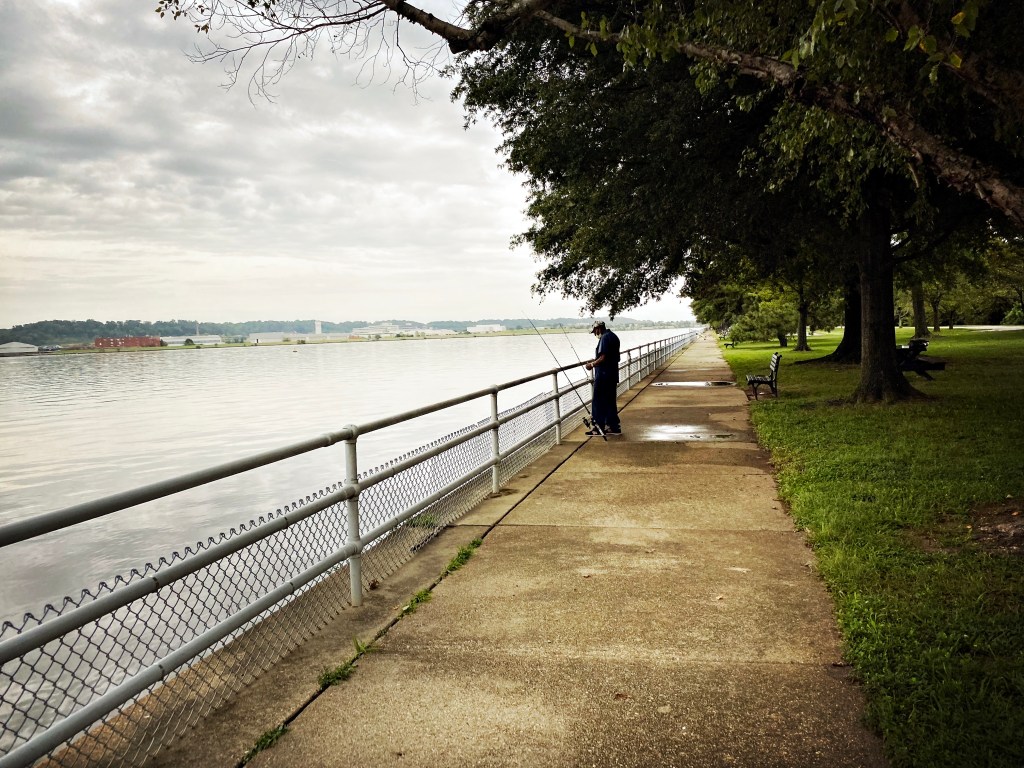
It is also a popular spot for fishermen.

As we rounded the point, the Potomac was very serene with not a boat in sight.

Across the river, in Virginia, Washington National Airport was also very quiet. Normally, planes are landing and taking off every minute but things have changed dramatically during the time of Covid.

In fact, during our entire walk alongside the Potomac which took over half an hour, this is the only plane we saw coming in to land.

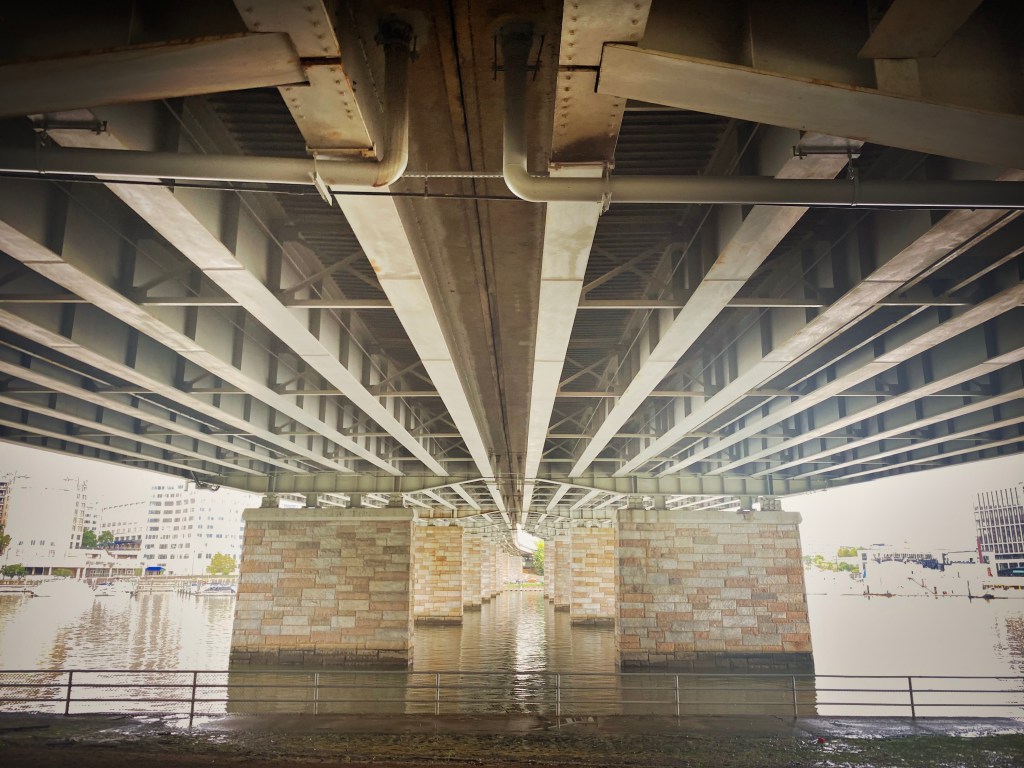
There are numerous bridges crossing this part of the Potomac, and we passed by and under a number of them.

Sitting practically under one of the overpasses is what has been called Washington’s most obscure memorial. The Cuban Friendship Urn, also known as the Maine Memorial, commemorates the 266 crewmen who died in 1898 when the USS Maine exploded and sank in Havana’s harbor. The disaster sparked the Spanish-American War, during which the United States liberated Cuba from Spain. The urn resided in front of the Cuban embassy for a number of years but when the relationship between the two countries deteriorated it was removed to a warehouse where it languished for several decades. It wasn’t until recently that it was rediscovered and placed in its current location.

We also passed by the George Mason Memorial. Dedicated in 2002, it is a rather modest memorial for one of the country’s most prominent founders. The bright red purse sitting next to Mason made us smile.

As the author of the Virginia Declaration of Rights in 1776, Mason created the first constitutional protection of individual rights. The Declaration of Independence, United States Bill of Rights, and the United Nation’s Universal Declaration of Rights all drew inspiration from Mason’s writings. Certainly, the similarity between Mason’s words from the Virginia Declaration and Jefferson’s words from the Declaration of Independence are unmistakable. Here’s Mason “All men are born equally free and independent and have certain inherent natural rights . . . among which are the enjoyment of life and liberty, with the means of acquiring and possessing property, and pursuing and obtaining happiness and safety.” And here’s Jefferson “We hold these truths to be self-evident, that all men are created equal, that they are endowed by their Creator with certain unalienable Rights, that among these are Life, Liberty and the pursuit of Happiness.”

Speaking of Jefferson, we also passed his memorial, a much more impressive structure. It was under repair and surrounded in scaffolding so not particularly photo worthy at the moment. On the other hand, the view from the platform in front of the Memorial and across the Tidal Basin to the Washington Monument and the Bureau of Engraving and Printing was worth a picture. Normally, the Basin is dotted with tourist driven paddle boats. But tourists are a rare sight in Washington at the moment and consequently not a boat was in sight.

Day 95

Columbia Heights (September 6, 2020)

It’s been very hot and humid over the last few weeks and the streets have been less than inviting. Hence, it’s been a while since our last blog entry. However, the heat and humidity finally broke so we headed out onto the streets of Columbia Heights. Lots of people were out taking advantage of the beautiful day. This had its pluses and minuses. On one hand it was nice to be out among people again and the world almost seemed normal. On the other hand, the large number of other pedestrians required plenty of dodging and darting to attempt to maintain a safe distance. Such is life during a pandemic.

We started out walking down 15th Street NW on the west side of Malcolm X Park where we saw this beautiful Spanish style home.

Next door was another beautiful building, the Josephine Butler Parks Center.

Currently used as an event center (Lauren, in fact, once performed at an event there during her belly dancing career), in past lives it was the Embassy of Hungary as well as Brazil. The Renaissance Revival-style mansion was designed by George Oakley Totten Jr., a noted architect who designed over a dozen major embassy buildings across the city. The developer of the property was Mary Foote Henderson, widow of the Missouri senator who introduced the 13th Amendment giving African Americans the right to vote. The center is named for Josephine Butler (1920-1997). The granddaughter of slaves, Ms. Butler was one of Washington’s most respected community leaders. Among other accomplishments, she started America’s first ever union of black women laundry workers and co-founded the statehood movement for the District of Columbia.

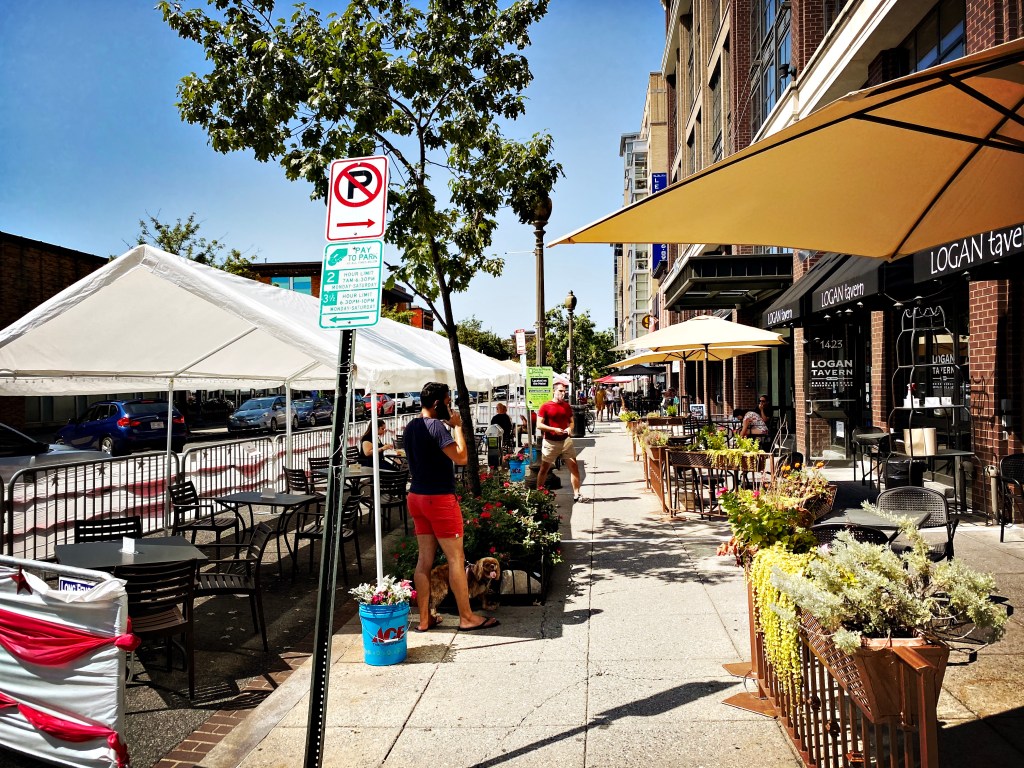
There are many restaurants, bars and cafes in the area. To accommodate more outdoor diners during the pandemic, the city has allowed restaurants to expand into the street.

Walking up 14th Street, we passed the Black Cat nightclub where Mal has spent many a happy night checking out indie bands from far and wide.

On one particularly memorable evening in the late nineties he saw New Zealand indie rock god, Chris Knox. The concert took place during a snow storm and consequently there were only twenty or so of us in the audience. We all sat around Chris while he played songs from his latest album, Yes!!. He also asked for requests but in true Chris Knox fashion would then refuse to play them. As well as being an innovative musician, the father of New Zealand punk, and one of the founders of the iconic Flying Nun Records label, Chris also made incredibly original music videos, wrote movie, television and music reviews, and drew comics. If you were a college student in New Zealand during the eighties and nineties, he was impossible to miss. Unfortunately, he suffered a debilitating stroke in 2009 effectively putting a stop to the output of one of New Zealand’s most creative geniuses.

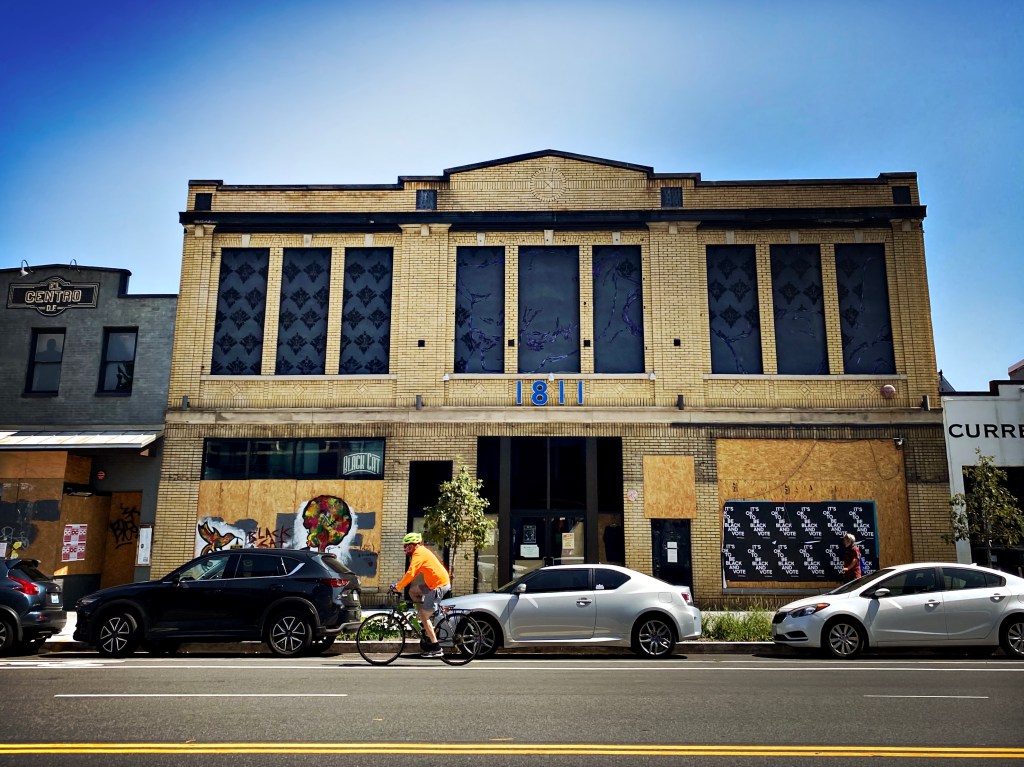
There are many Black Lives Matter tributes throughout the neighborhood. This one was particularly poignant, juxtaposing the names of young African Americans who had their lives taken far too early against the smiling photo of a young African American man in a neighboring advertisement.

Day 94

Logan Circle / Shaw (August 4, 2020)

Back in Logan Circle and Shaw, we were once again joined by Ross along with another dear friend, Maggie, who lives in Shaw.

We started our exploration in the Blagden Alley-Naylor Court Historic District, named after two nineteenth century property owners. It consists of a number of alleys bounded by 9th, 10th, M and O Streets. Today it is the home of a number of trendy restaurants, cafes and bars.

If you are craving a high end cocktail or two we recommend the Columbia Room, a hidden little speakeasy tucked into one of the alleys.

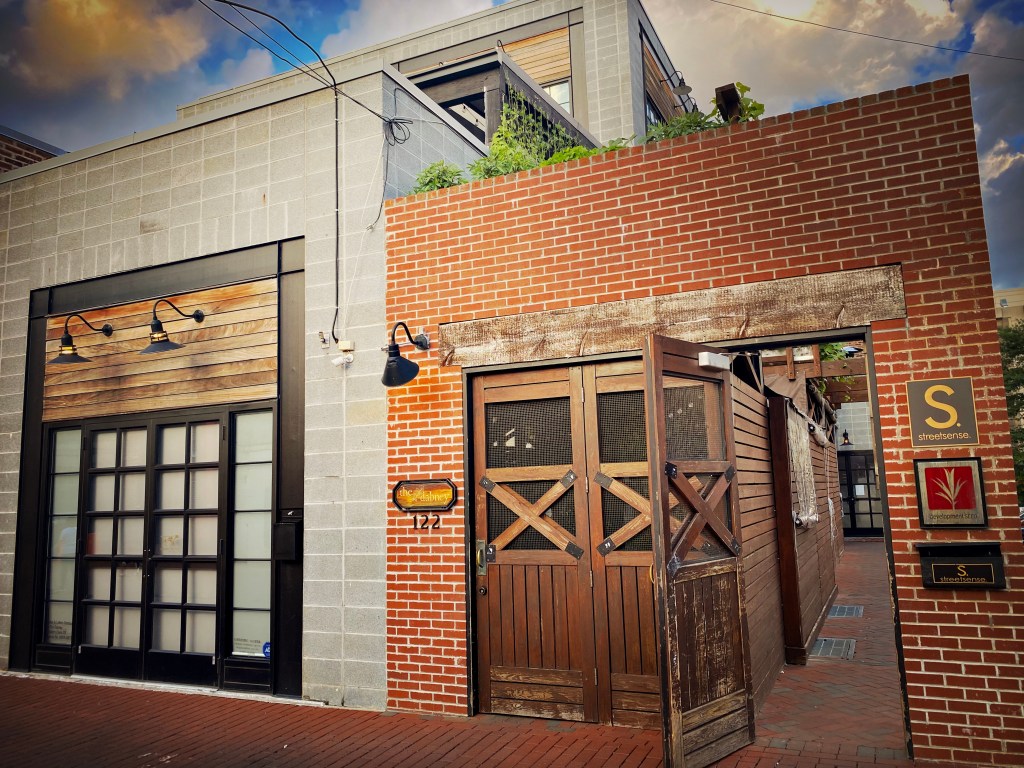
Next to the Columbia Room is one of the District’s highest rated restaurants, The Dabney. We hear that it is very good although we have never been able to get a reservation.

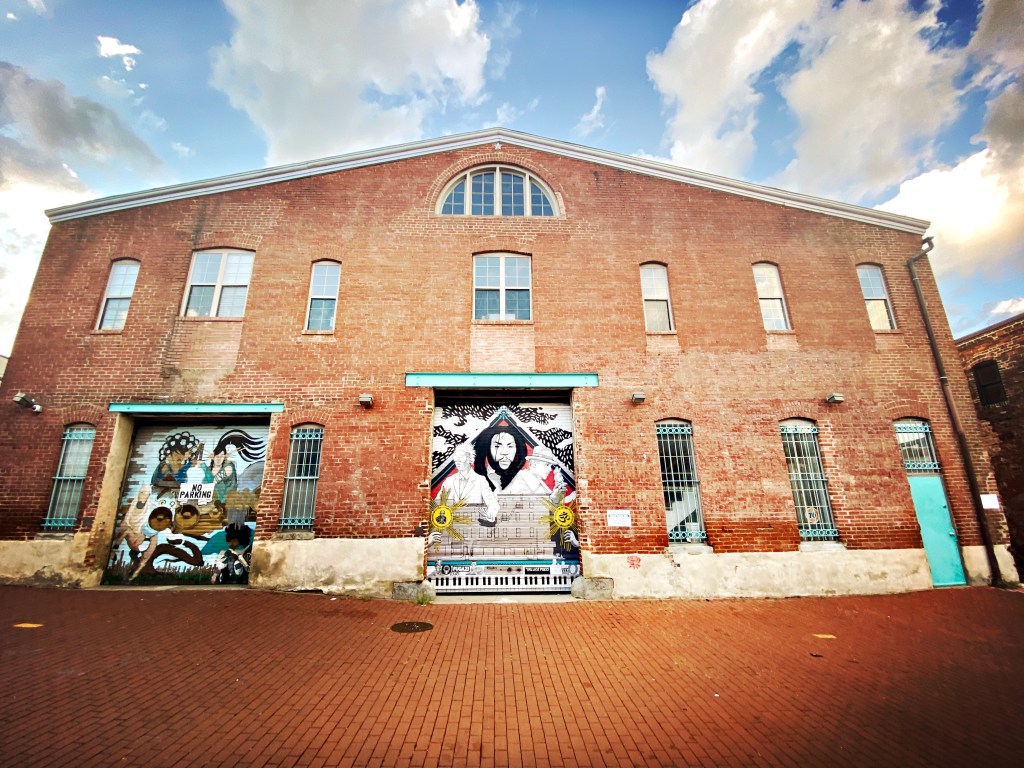
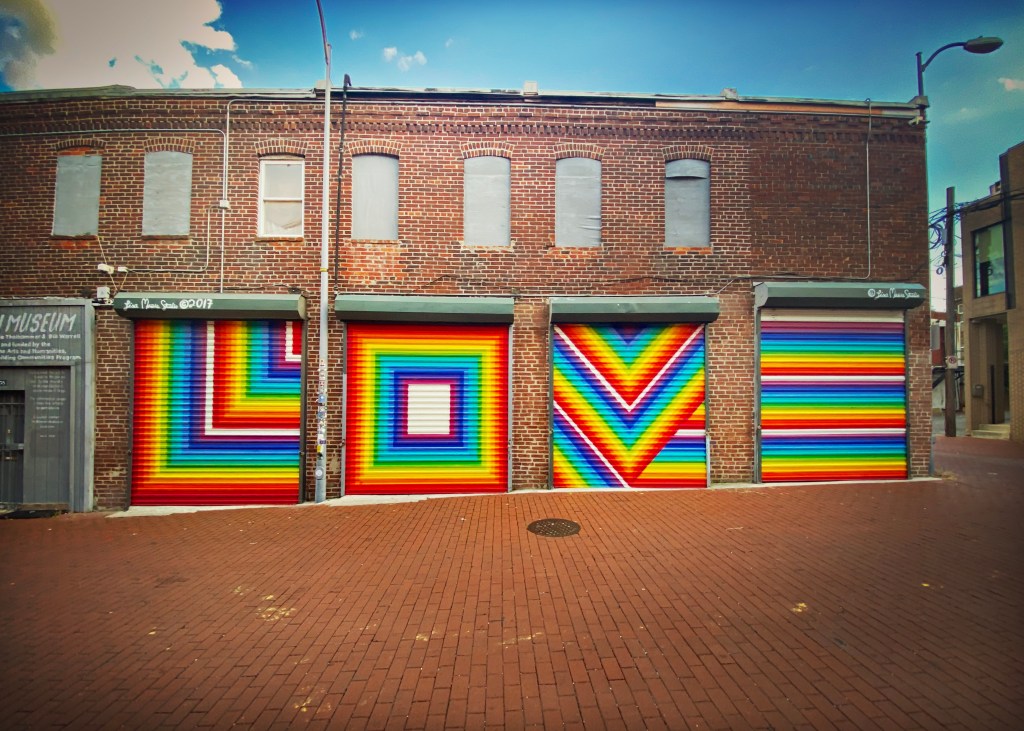
A number of the building have cool murals.

Including this one by local artist Lisa Marie Thalhammer called appropriately, Love.

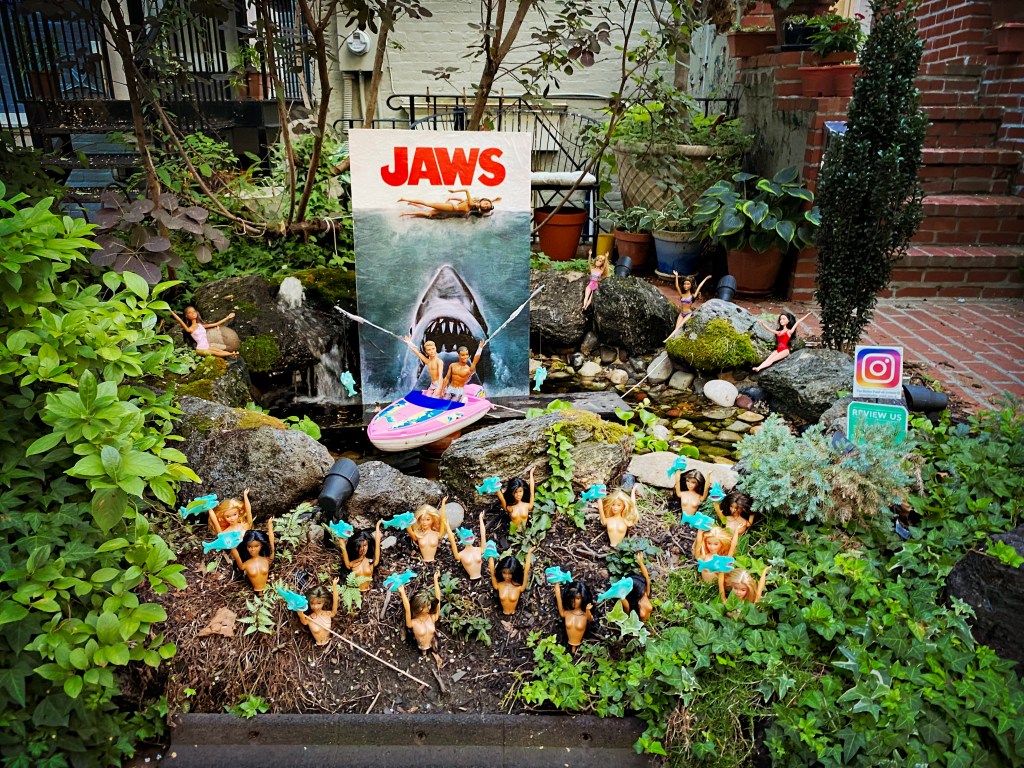
From the alleys, we made our way west back into the Logan Circle neighborhood. We once again passed the Barbie Pond that we discussed during our last post. We were delighted to see that the display had been updated.

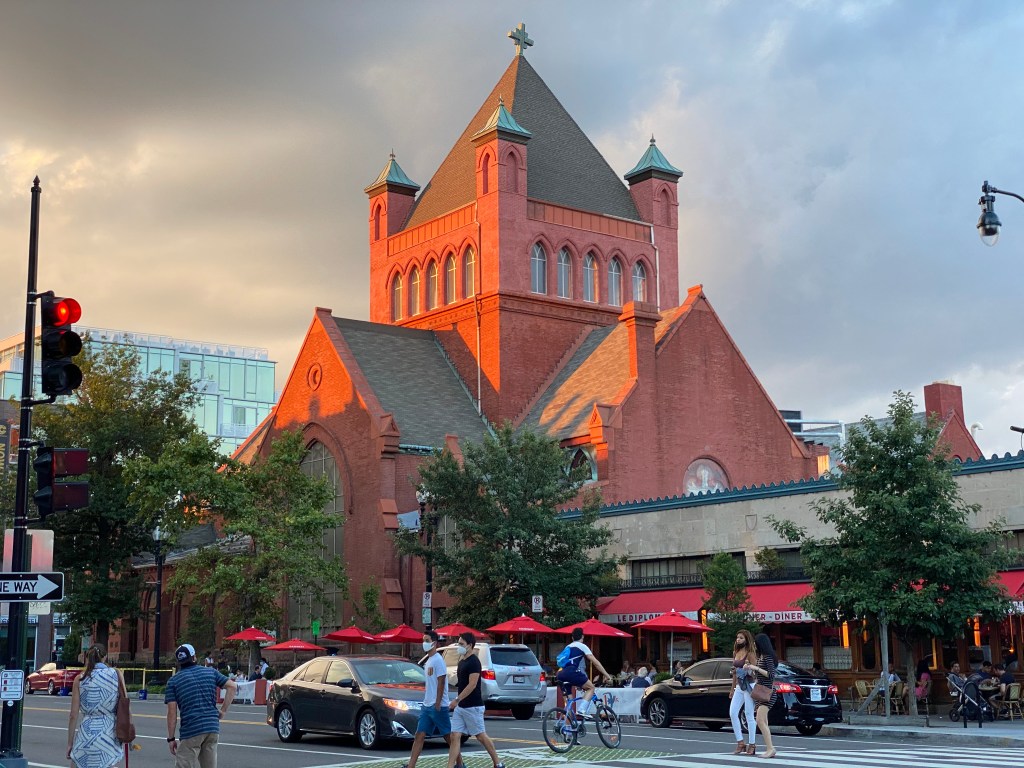
We also crossed 14th street where the John Wesley African Methodist Episcopal Zion Church was lit up beautifully by the late afternoon sun.

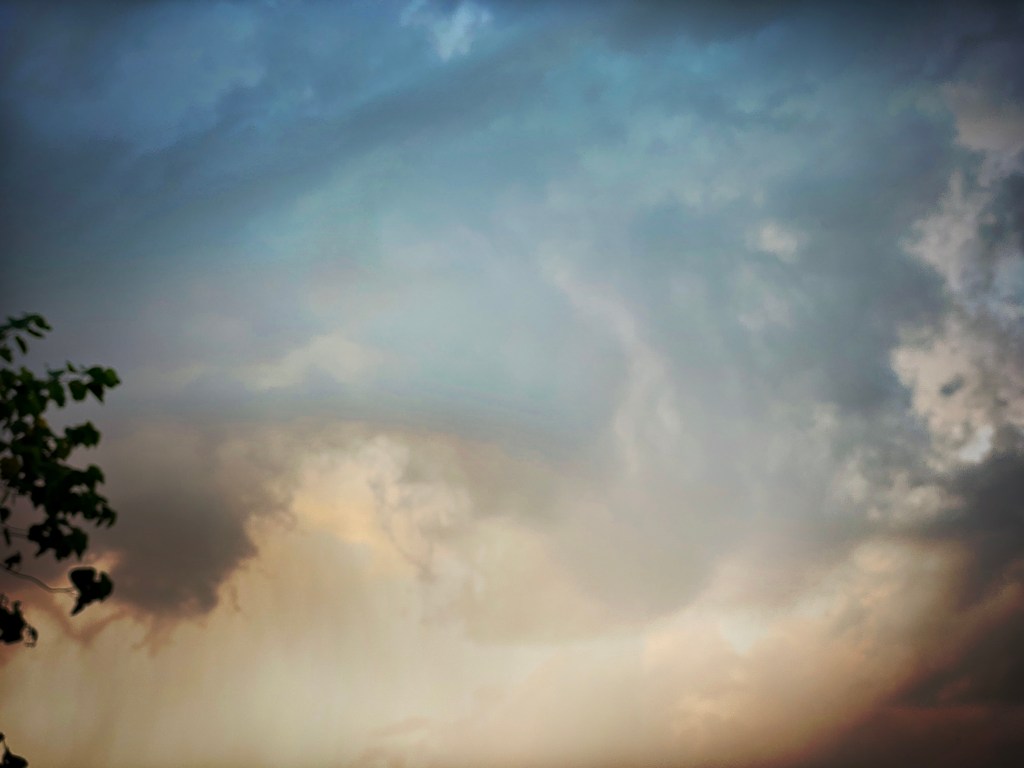
The sky itself was putting on quite a show.

We passed by the Embassy of Kazakhstan with its statue of the Golden Warrior.

The statue is of a Scythian warrior whose remains were recovered from a burial mound in Kazakhstan in 1969. The warrior was discovered wearing a gold-plated uniform, along with a gold dagger and sword, and pointed headdress with plaques of winged horses with horns, panthers, goats, and other animals. The Golden Warrior has become a symbol of Kazakhstan. The Washington D.C. statue, commemorated in 2006, is a replica of the Golden Warrior featured in the Independence Monument in the Republic square, in downtown Almaty. The legend goes that touching the statue in Almaty can bring you a life of happiness and prosperity. Hence many people, including lots of newlyweds, will come to touch the statue. The Kazakhstan Embassy welcomes you to touch the statue in front of the embassy to see if it similarly enhances your life.

We passed this building which was a little different from the ones we normally see during our walks

We also liked this little row house tucked in at an angle between other buildings.

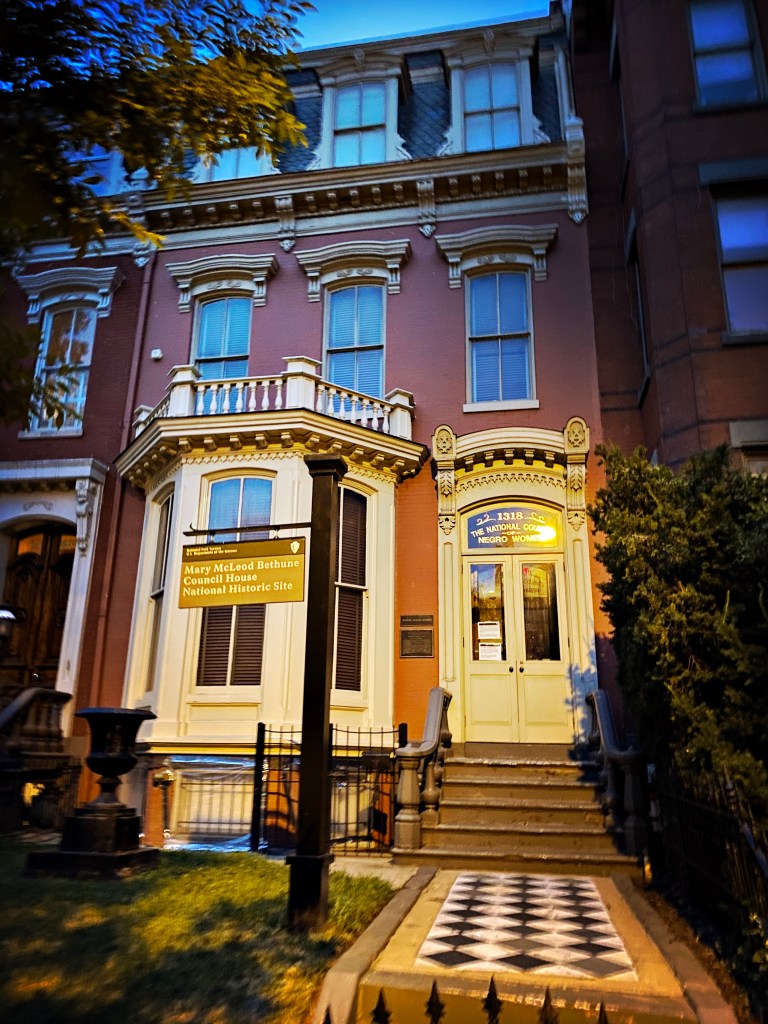
We also passed the Mary McLeod Bethune house that was the first headquarters of the National Council of Negro Women (NCNW) and was Bethune’s last home in the District.

Bethune, the daughter of slaves, went on to become a prominent American educator, stateswoman, philanthropist, humanitarian, and civil rights activist. She founded the NCNW in 1935 and became a national advisor to Franklin D. Roosevelt. It would take too long to recite all of her achievements here. Needless to say, she was a very impressive woman and we recommend spending some time getting to know her story.

We also passed the National City Christian Church on Thomas Circle. The neoclassical church was designed by John Russell Pope and completed in 1930. Apparently, his design was influenced by the St. Martin-in-the-Fields church that sits in Trafalgar Square in London. Certainly, it’s easy to see the resemblance between the two churches. Pope has designed a number of famous buildings around town including the National Archives, the Jefferson Memorial and the National Gallery of Art. Among the church’s notable members have been two Presidents, Lyndon Baines Johnson and James Garfield.

Having spent some more time exploring Logan Circle we made our way back into Shaw where we passed the O Street Market.

The market now contains a thriving upmarket Giant Supermarket but has gone through some troubled times since it began life as a public market in the 1800s. In particular, the market gained some infamy in the 1990s when it was the site of a shooting. Five men entered the market on March 31, 1994 and fired more than 30 rounds killing one man and wounding eight others.

If you are looking for a place to stay in Shaw we highly recommend the O Street Inn, owned and run by our good friend and neighbor Charlet. It is in a great location and has been totally renovated recently.

We ended our walk back where we started, in the Blagden Alley-Naylor Court Historic District as night was falling. Tucked into the alleys are some cool residences.

As well as the Sundevich sandwich shop

and the Washington DC Archives and Public Records building

Day 93

Logan Circle (July 31, 2020)

This evening we explored Logan Circle, accompanied by our good friend Ross who lives in the neighborhood. Speaking of Ross, we would like to give a shout out to Ross’s parents, Camille and David, who live in England. We are looking forward to seeing them both on this side of the pond again once the current madness ends.

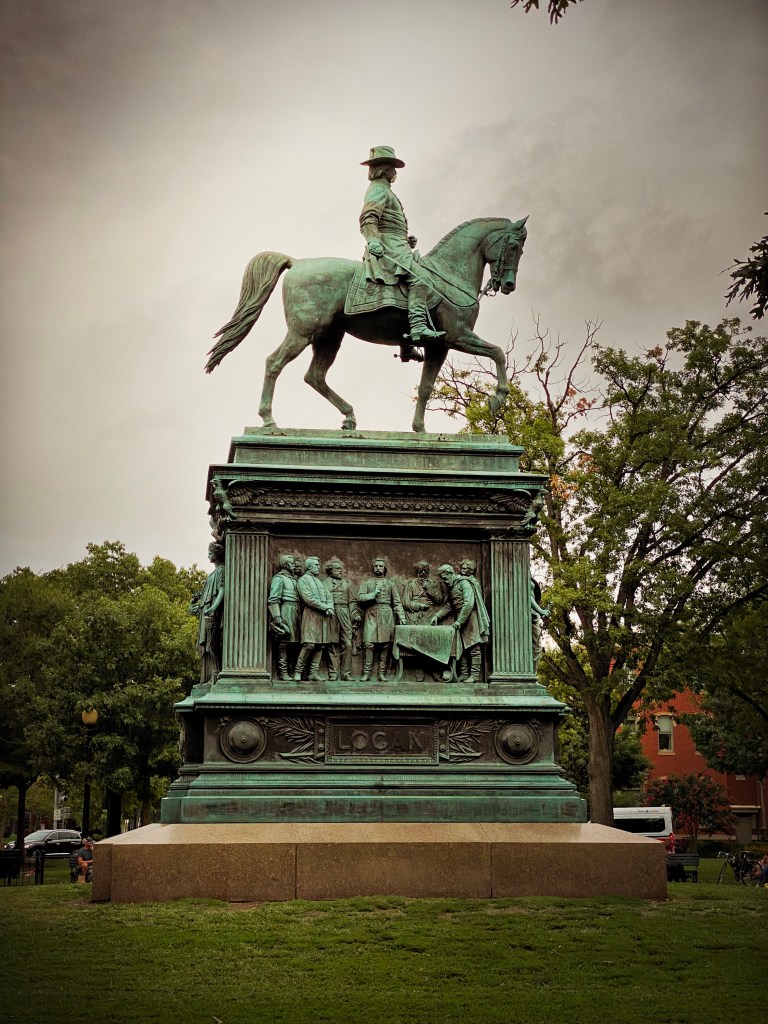
We started at the circle that gives the neighborhood its name. The circle surrounds a massive equestrian statue of John A. Logan, a Union General during the Civil War.

Logan, known as Black Jack by his troops because of his dark hair and eyes, is regarded as one of the Union Army’s most successful generals. He took part in a number of battles and was wounded twice. General Ulysses Grant, in writing to President Lincoln, described Logan as “a most valuable officer and worthy of every confidence . . . There is not a more patriotic soldier, braver man, or one more deserving of promotion.”

The statue, dedicated in 1901, was sculpted by Franklin Simmons and the base was designed by Richard Morris Hunt who has designed a number of prominent American buildings, including the Metropolitan Museum of Art in New York City.

The Circle is surrounded by large townhouses including one where Logan actually lived.

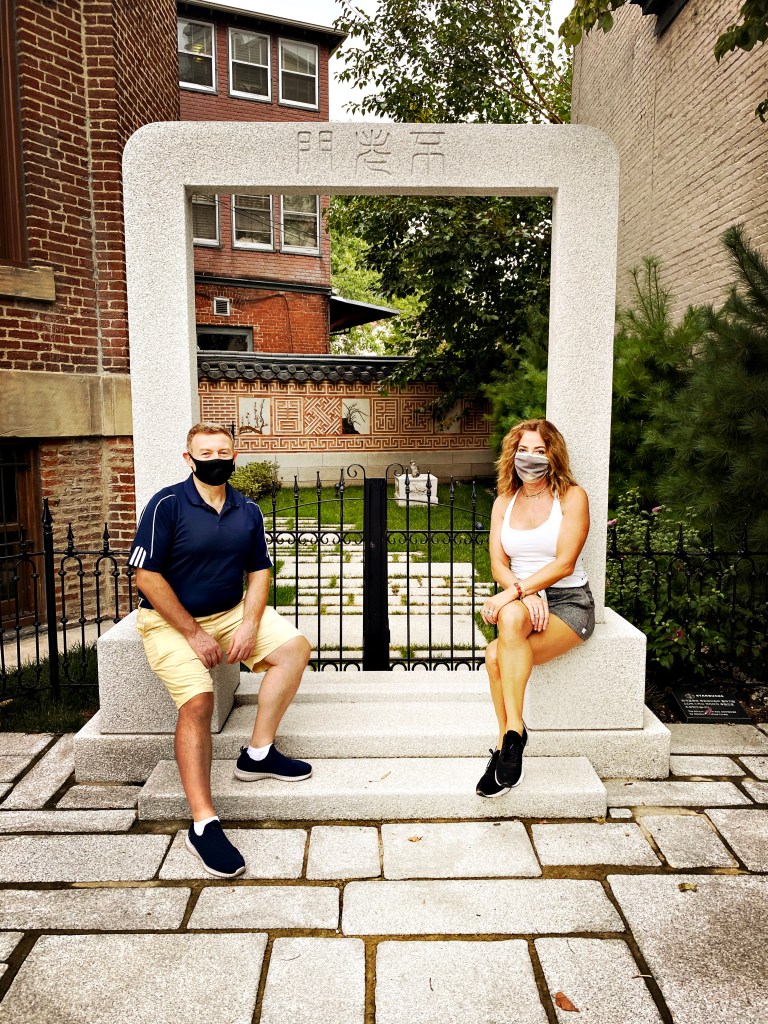
Another interesting building on the Circle is The Old Korean Legation building. The building began its life in 1877 as the home of another American Civil War hero, Seth Ledyard Phelps. Phelps was a Union naval officer serving with distinction during the Mississippi River campaigns. He commanded squadrons of gunboats that played key roles in riverboat assaults on Confederate troops during various battles.

The Korean government bought the building in 1891 for $25,000 but did not own it for long. When Japan took power over Korea in 1905, it sold the building for $10 to an American buyer. In 2012, the National Trust for the Cultural Heritage of the Republic of Korea and the Cultural Heritage Administration purchased the building for $3.5 million. The building was renovated and now includes a Korea Garden and a granite “Eternal Youth Gate” also known as bulomun in Korean. The building contains a museum that is currently closed due to the pandemic.

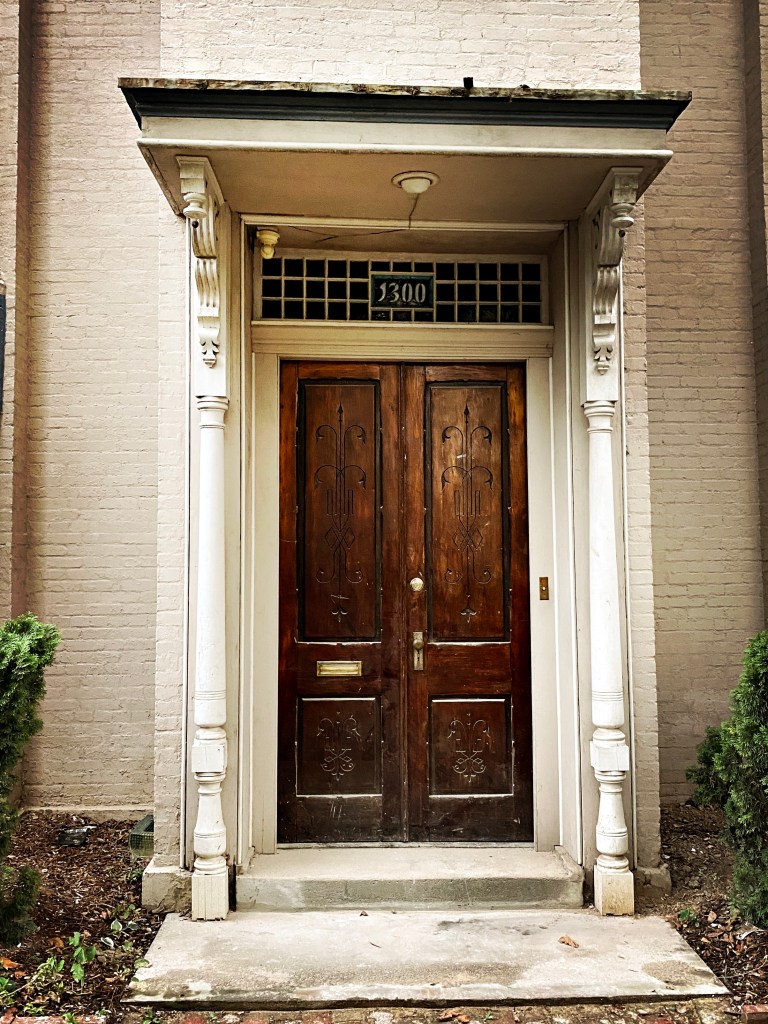
There are a number of beautiful houses, rowhouses and duplexes in the neighborhood.

A number had beautiful front doors.

Some of the coolest places are tucked into the back alleys which where carriage houses once stood. This modern one particularly took our fancy.

Tucked into the same alley was the Kingman Boys and Girls Club which caught our attention with its bright green windows and doors.

The club offers children after school and summer-long daycare, cultural outings and celebrations, athletic and recreational activities, employment opportunities and life-skill workshops. It serves approximately 120 District kids from 6-18 years old.

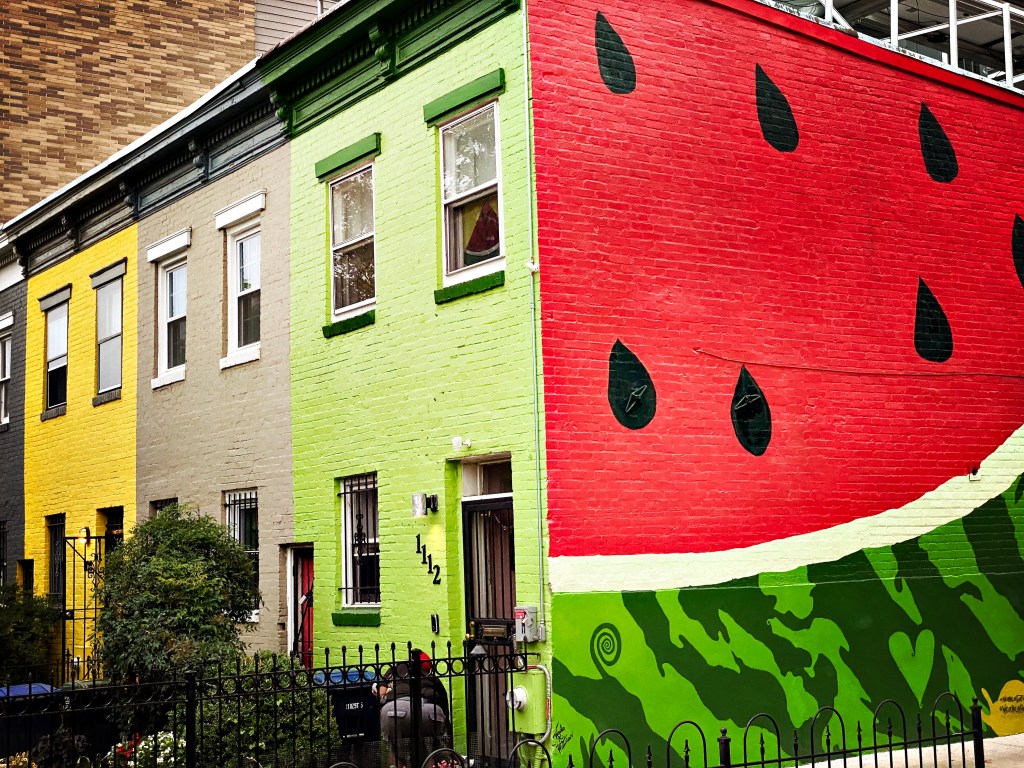
We liked these brightly colored row houses with their watermelon mural.

Running through the middle of the Logan Circle neighborhood is 14th Street NW, which over the last few years has become one of the District’s hottest night time destinations, with numerous restaurants, bars, cafes, clubs, theaters and stores. Like the rest of the city, the street has been hit hard by the pandemic and many of the venues are currently closed. However, one place that apparently continues to go strong is the French bistro, Le Diplomat. Its terraces were packed. It even had expanded into one lane of an adjacent road.

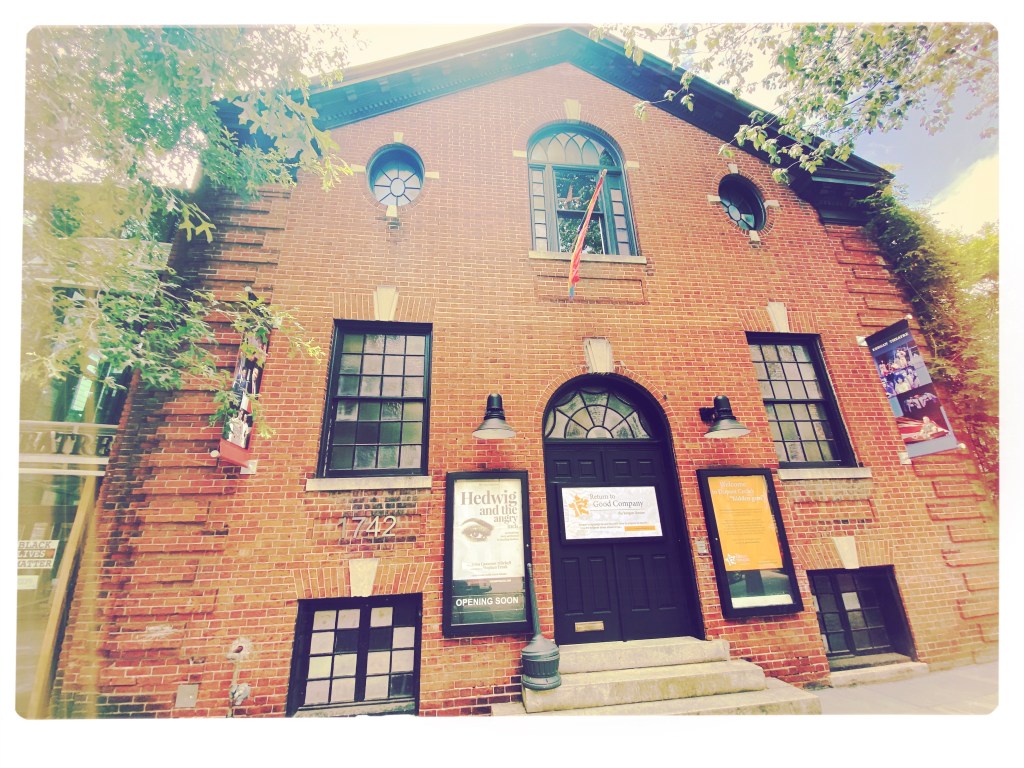
Just down the block from Le Diplomat is one of Washington’s premier venues for contemporary theatre, the Studio Theatre, which was founded in 1978. The venue has four theatres and over the years, it has won over 72 Helen Hayes Awards for excellence in professional theatre. We are not sure if it still does, but The Studio Theatre also used to offer acting lessons. We know this because, back in the nineties, Lauren took a couple of courses at the Studio and performed in a couple of student plays at the venue.

Due to the pandemic, the Studio is not currently showing any performances.

Despite the unpleasantly high heat and humidity that is a feature of the city’s Summer, we don’t often come across tropical plantings. Here is a rare exception.

We like this building with its wall of buddhas.

During our walks we have come across a number of quirky front yard installations but this was definitely one of the quirkiest.

According to Ross, The Barbie Pond on Q Street features a rotating cast of Barbies celebrating different themes depending on the time of the year. Can you guess the current theme? The pond even has its own Instagram page which you can check out at barbie_pond_ave_q.

As the night fell we made our way back through the darkening streets

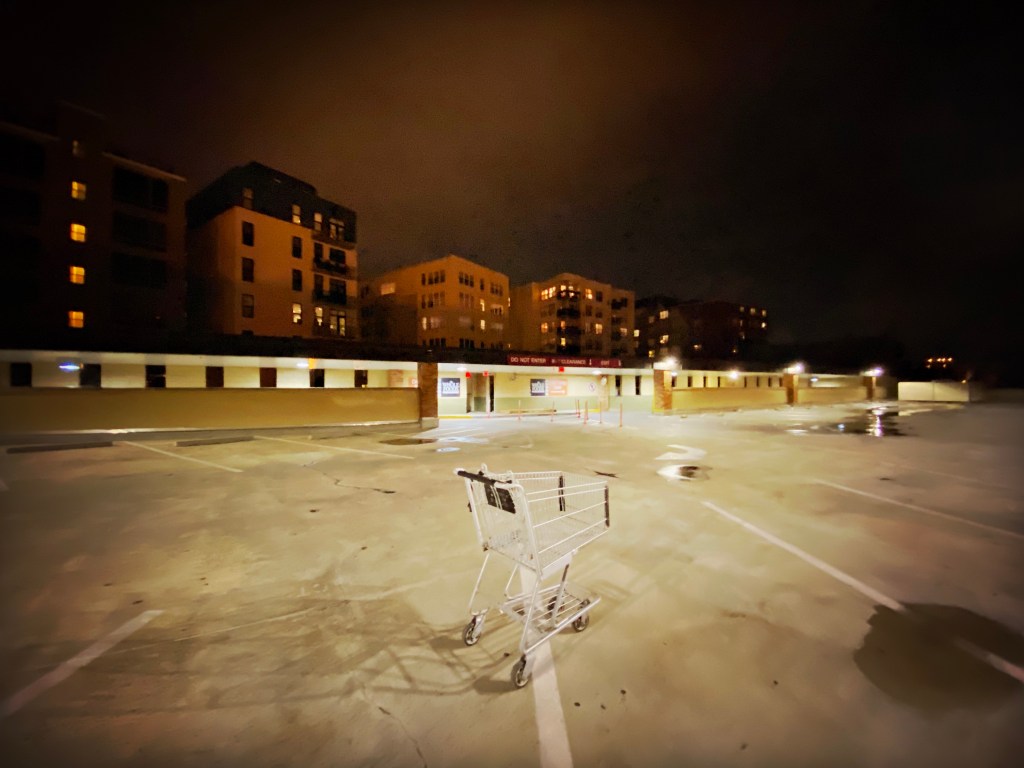
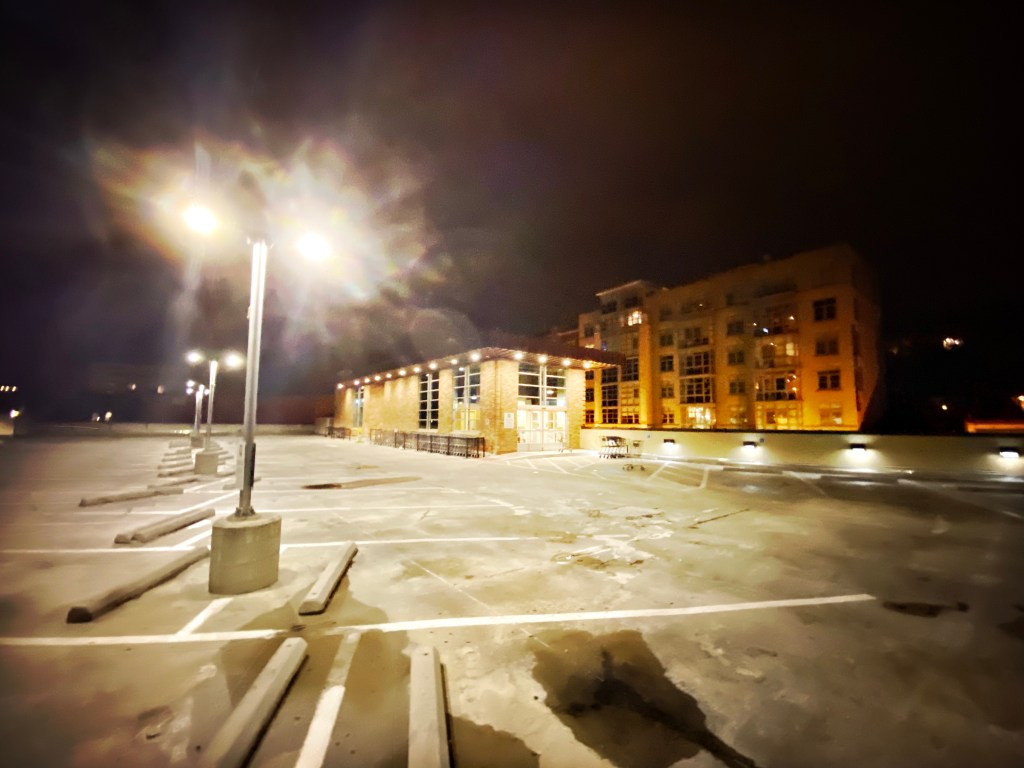
To our car which was parked on the roof of the local Wholefoods market which by this stage of the night was totally empty.

Day 92

Black Lives Matter Plaza (July 11, 2020)

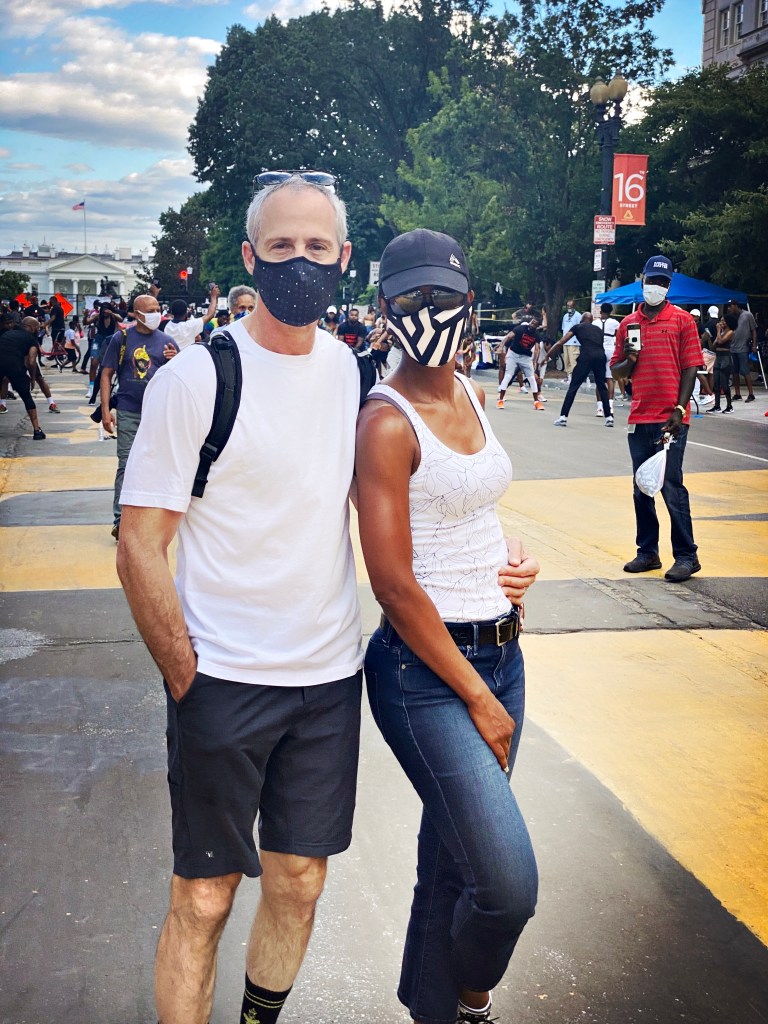
Today was our shortest walk but also the most powerful. We walked the two blocks of 16th Street that have been renamed Black Lives Matter Plaza.

The plaza was renamed by black Democrat Mayor, Muriel Bowser, on June 5, 2020, after the District Department of Public Works painted the words “Black Lives Matter” in 35-foot yellow capital letters, along with the flag of Washington, DC, on the street, as part of the George Floyd protests. At a later stage, activists added “Defund the Police” in similar letters at the end of the mural.

Lauren’s brother, Howard, and his wife Carolyn have been visiting us from Massachusetts. It was great to have them join us for today’s walk.

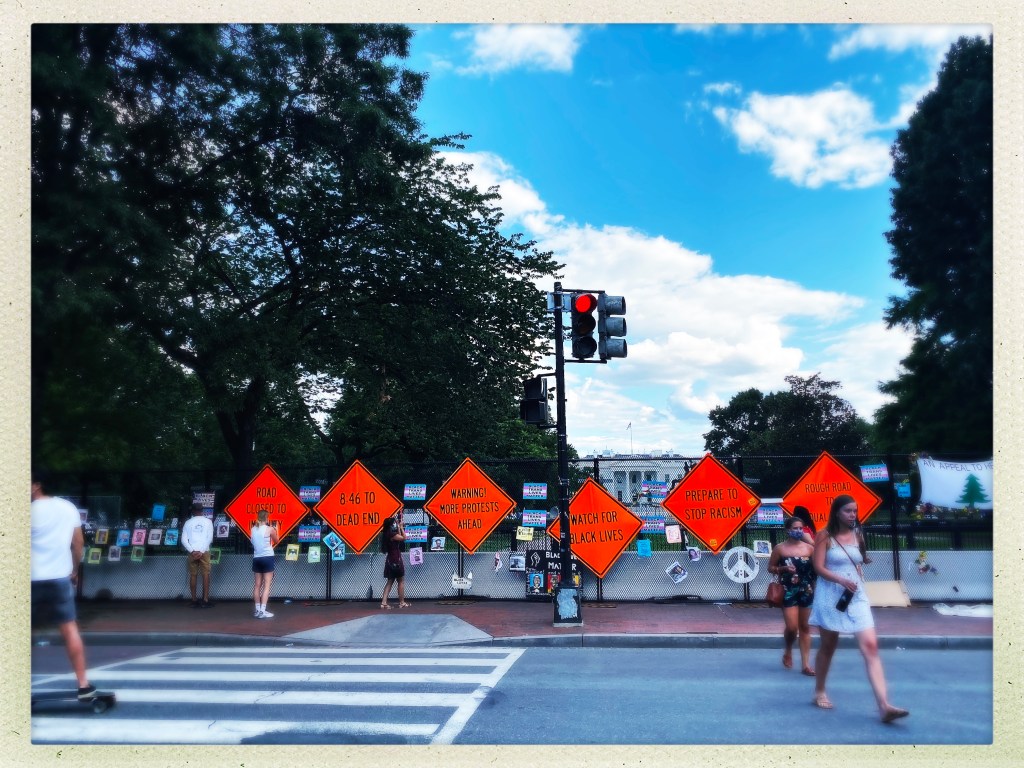
At the end of the Plaza is a makeshift fence that cuts off the White House from the surrounding Republic. It also serves as a community message board.

On the corner of the Plaza is St. John’s Episcopal Church. On June 1, 2020, amid the George Floyd protests, police and National Guard troops used tear gas and other riot control tactics to forcefully clear peaceful protesters and create a path for President Trump and senior administrative officials to walk from the White House to the church. Trump did not enter the church but instead stood out front awkwardly holding up a bible to create an infamous photo op. The church is sometimes referred to as the Church of the Presidents as every sitting president has attended the church at least once since it was built in 1816.

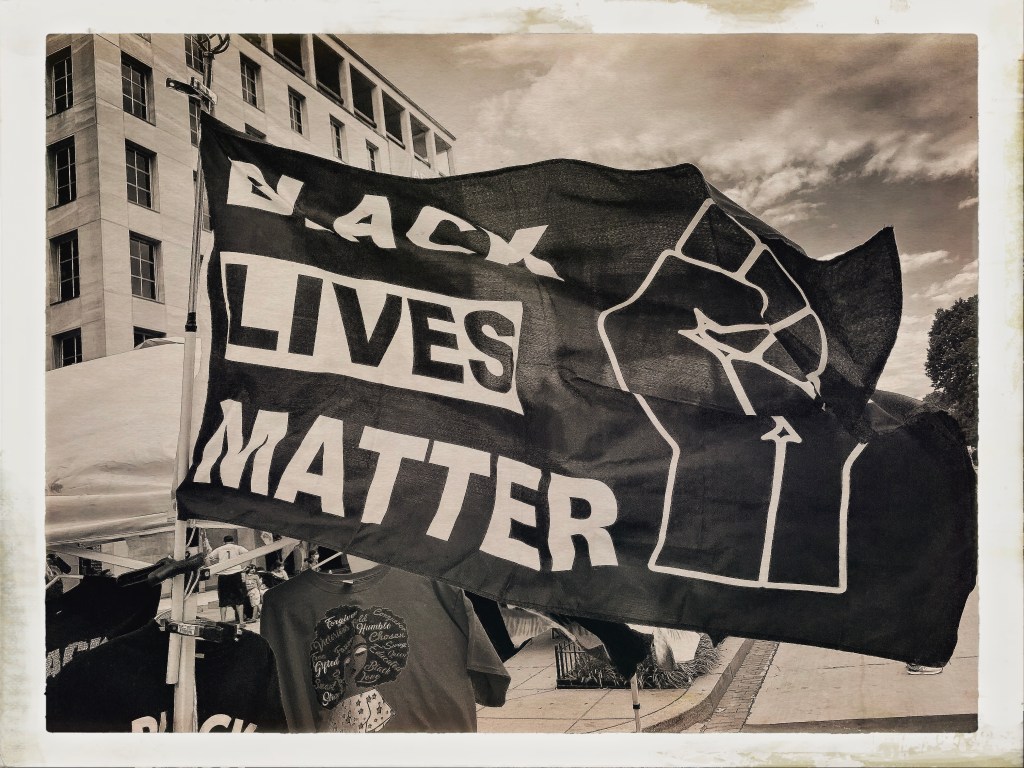
Lining the Plaza are stalls selling t-shirts, flags and other souvenirs.

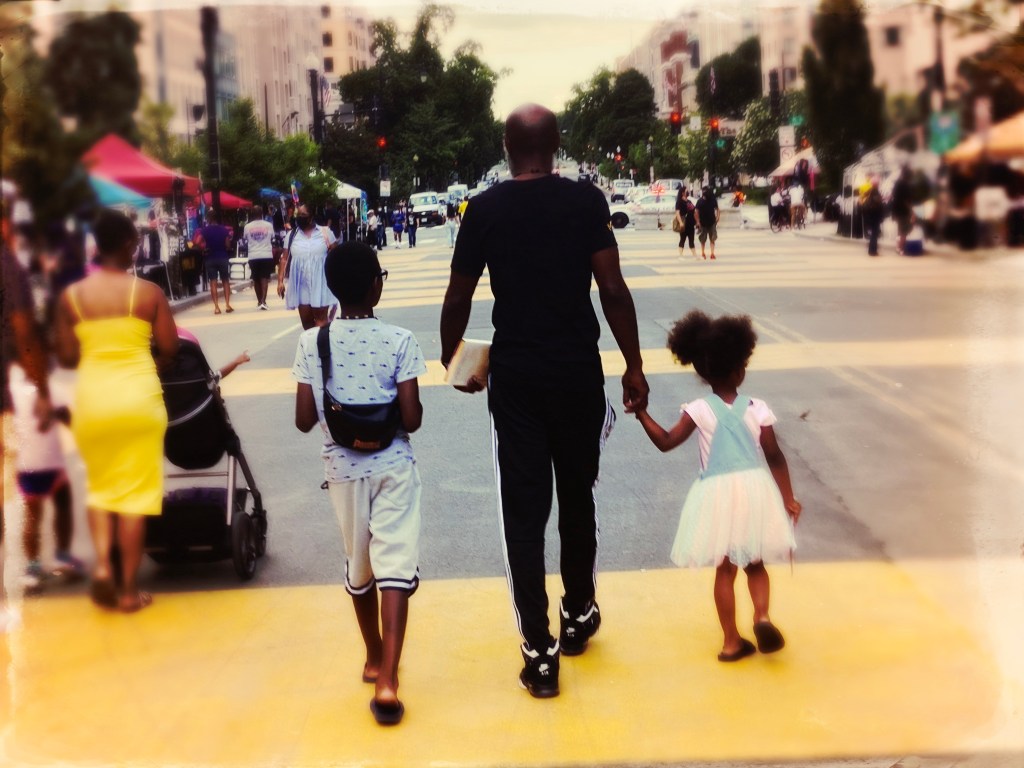
We hope that a safer future awaits this man and his children.

Day 91

Dupont Circle (July 10, 2020)

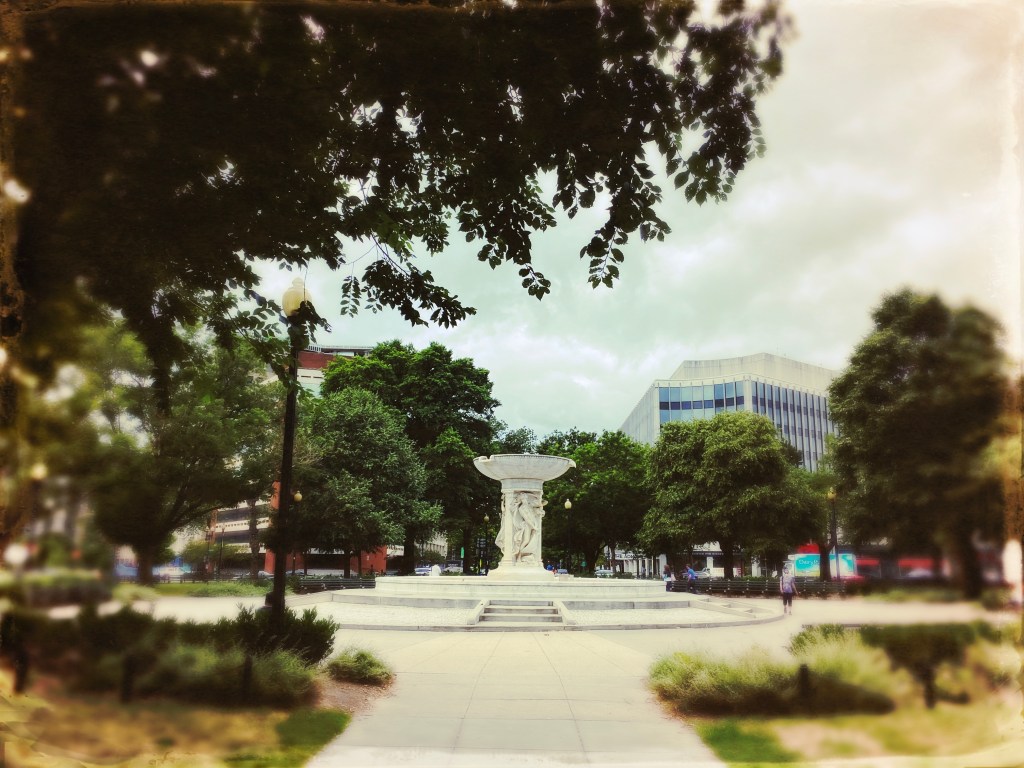
We started our second day in Dupont Circle at the Circle itself.

The Circle is named after Samuel Francis Du Pont (1803-65) who was a rear admiral in the United States Navy and the nephew of E.I. du Pont, the founder of the du Pont chemical corporation.

At the center of the Circle is a fountain designed by Henry Bacon and sculpted by Daniel Chester French. Bacon and French are also the architect / sculptor team behind the Lincoln Memorial. The basin at the top of the fountain is supported by three allegorical figures, the Arts of Ocean Navigation, representing the sea, the stars and the wind. The nude male figure pictured below represents the wind. He is holding a conch shell to use as a horn and is wrapped in a ship sail.

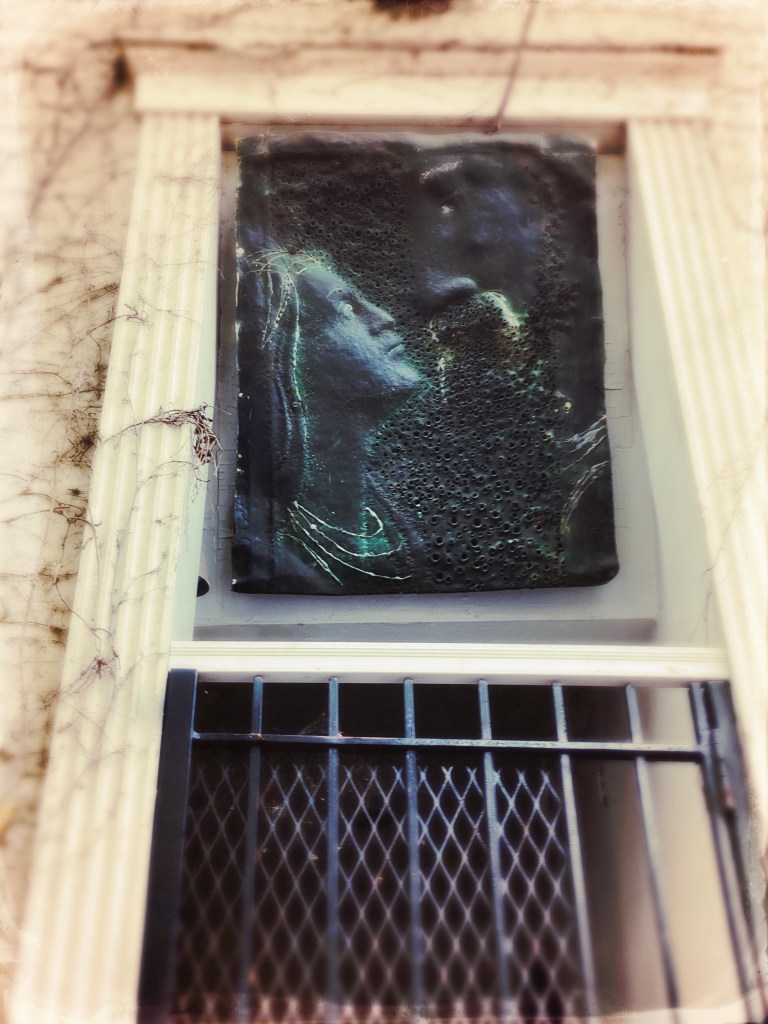
Speaking of sculptors, walking down Corcoran Street, we noticed that a number of the houses featured sculptures by the local sculptor, John Cavanaugh who we mentioned in a previous post.

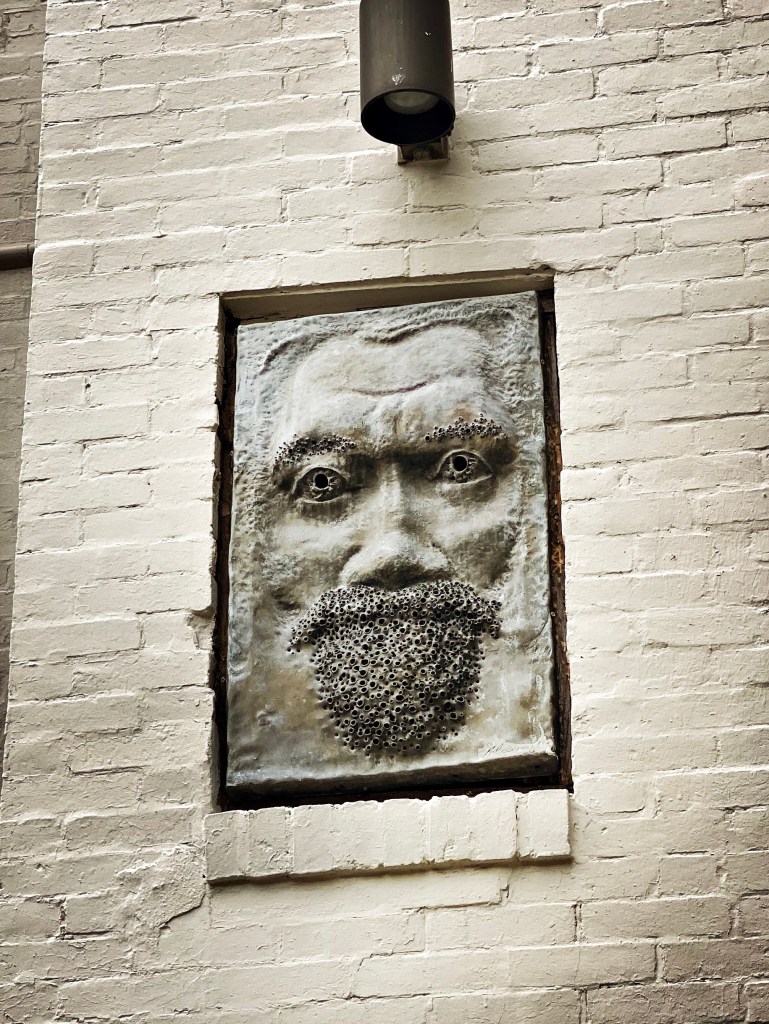
We don’t think the sculpture over this door was by Cavanaugh, but it was rather terrifying.

We liked these ferns and railing

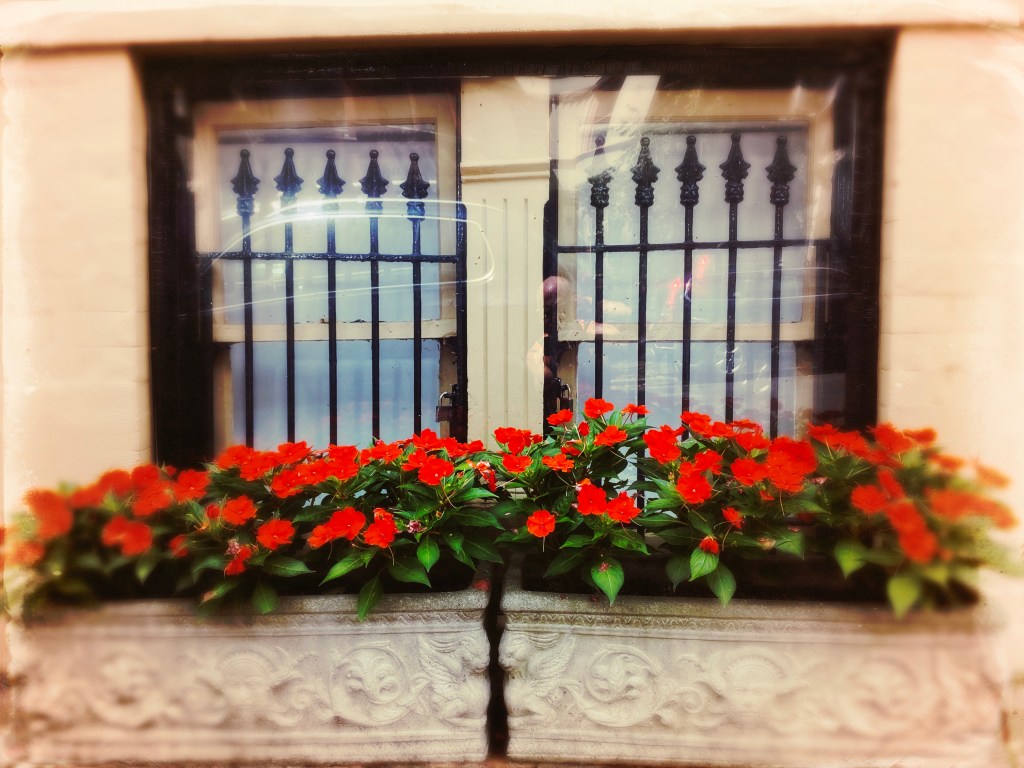
And this window box.

There are a number of embassies and chanceries in this part of Dupont Circle, including the Chancery of Mozambique pictured below.

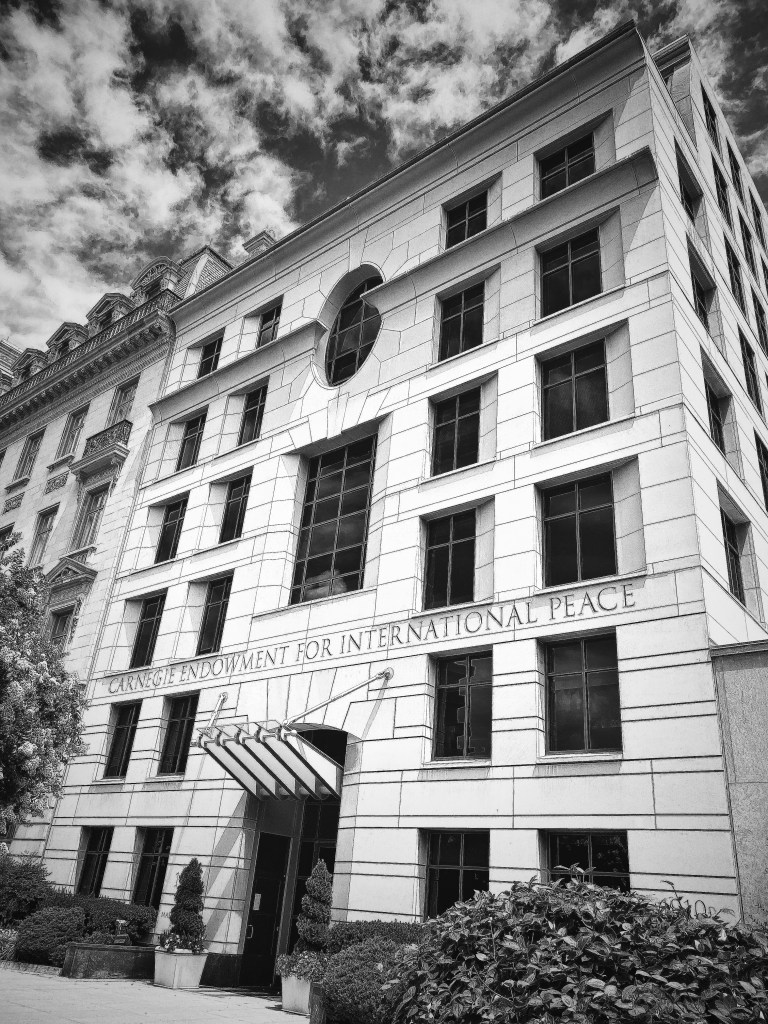
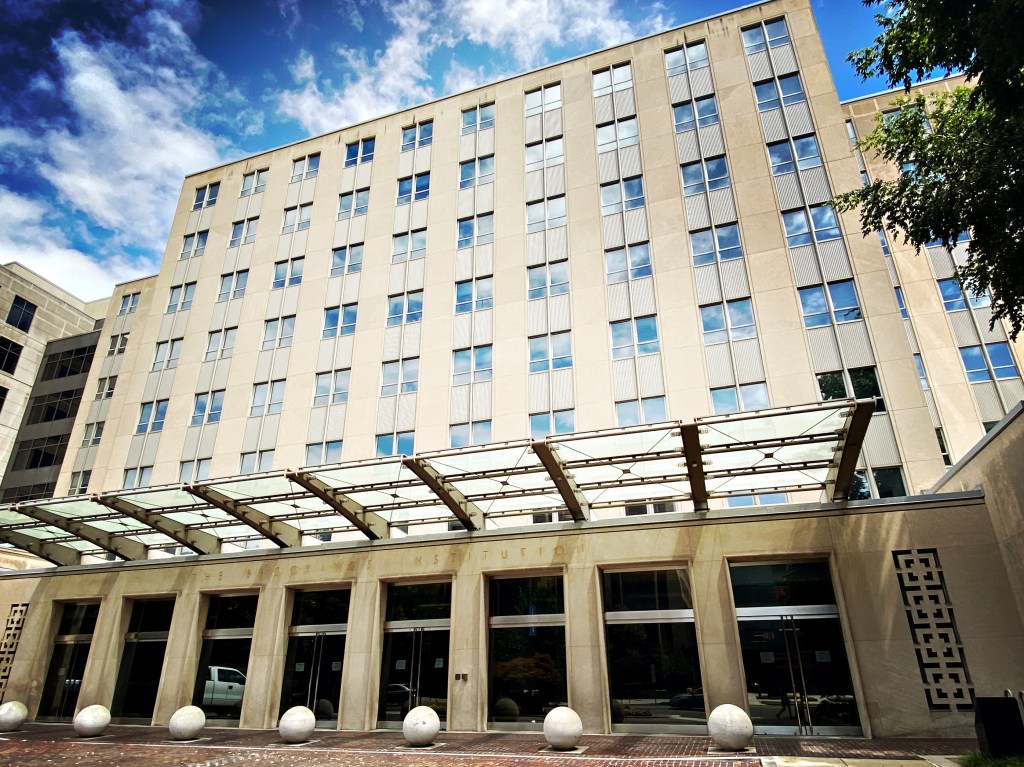
However, unlike the upper northwest part of Massachusetts Avenue which consists almost entirely of embassies, the avenue east of Dupont Circle includes many non-profit organizations, charities, and Think Tanks. Two well-known ones are the Carnegie Endowment for International Peace and the Brookings Institution.

One of the things that we have really enjoyed during our walks is coming across unexpected places and learning the stories of remarkable people. Today, walking down one of the small side streets that run through the neighborhood, we passed by a nondescript row house that, according to a plaque outside, had once been the home of Carl Lutz. Lutz (1895-75) was a Swiss diplomat who at one time lived and worked in the District and attended George Washington University. He served as the Swiss Vice-Consul in Budapest, Hungary during World War II and is credited with saving over 62,000 Jews. If you don’t know Lutz’s story, we encourage you to look him up. He was an incredibly brave and extraordinary person. Wikipedia provides the following example of Lutz’s bravery: “One day, in front of fascist militiamen while they fired at Jews, Lutz jumped in the Danube River to save a bleeding Jewish woman. With water up to his chest and covering his suit, the consul swam back to the bank with her and asked to speak to the Hungarian officer in charge of the firing squad. Declaring the wounded woman a foreign citizen protected by Switzerland and quoting international covenants, the Swiss consul brought her back to his car in front of the stunned fascists and left quietly. Fearing to shoot at this tall man who seemed to be important and spoke so eloquently, no one dared to stop him.”

We sometimes come across parks tucked in behind houses, that are probably only known to the locals. Here’s an example.

Here are the 16th street churches of the day.

Also tucked into one of the back streets is the The Keegan Theatre. In 2013, the company purchased the Church Street Theater. After an extensive renovation, the theatre was officially reopened with the play “Cat on a Hot Tin Roof” in 2015. The Keegan is now the resident theatre company of Dupont Circle.

Day 90

Dupont Circle (June 30, 2020)

Today we started exploring the Dupont Circle neighborhood. It is a beautiful and diverse urban neighborhood with lots to see. Since the 1970s, it has also been the center of Washington DC’s gay community. Hence, the rainbow street crossing.

Each year the neighborhood hosts the Capital Pride parade and holds the High Heel Race that pits dozens of drag queens against each other in a sprint down 17th street.

The neighborhood consists primarily of ornate and varied row houses, many of which have interesting gardens and art work. Here are some that we particularly liked.

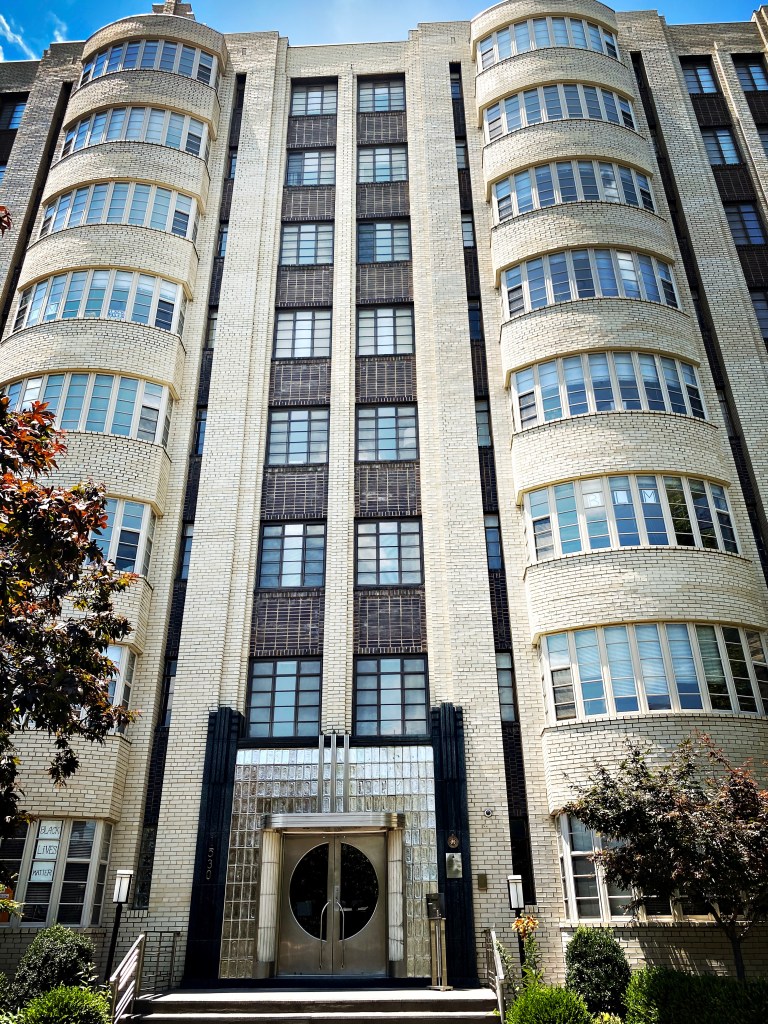
There are also some beautiful apartment buildings. We liked this deco building.

And this ornate building on the Circle itself.

This building had an English feel with its beautiful gardens.

We liked the fact that the residents of this building had co-ordinated their Black Lives Matter message.

Perhaps the building with the most interesting history that we passed was The Cairo.

The Cairo was designed by Thomas Franklin Schneider and completed in 1894. With 12 floors, it towered over the neighborhood when it was built. In fact, its height created such an uproar among local residents that they lobbied Congress to limit the height of future residential buildings in the District. They succeeded and as a result there is still a height limit for buildings within the District. Consequently, the Cairo remains the tallest privately owned building in Washington DC.

Another historic residence that we passed and enjoyed was Whittemor House. It was designed by Harvey Page and built in 1894 and currently is the home of the Woman’s National Democratic Club.

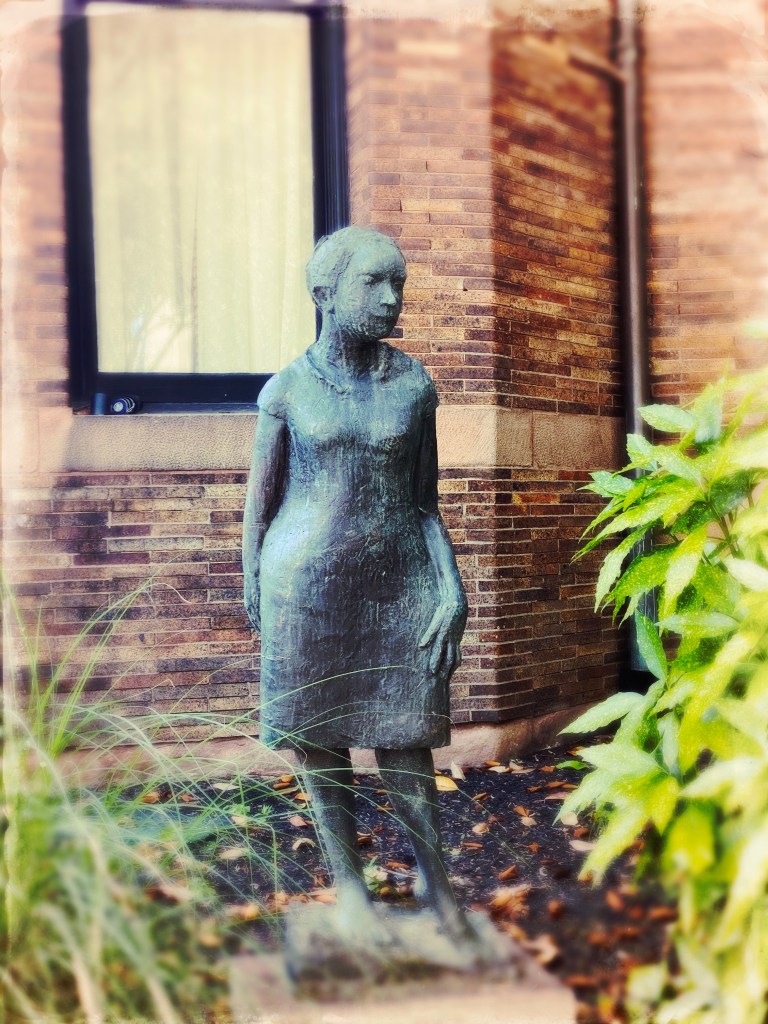
Alongside the house, set in a garden, are some interesting statues by the sculptor John Cavanaugh (1921-85) who had a studio nearby and was known as unofficial Mayor of Dupont Circle.

In our last blog entry we mentioned the intimidating Scottish Rite of Freemasonry lodge that we passed on 16th Street. Little did we know that there would be an even more impressive Scottish Rite lodge just a little further down the same street.

Built in 1915, The House of the Temple, was designed by John Russell Pope, the same architect that designed Meridian House that we discussed in our most recent blog entry. It serves as the headquarters of the Supreme Council, 33 degrees, of the Scottish Rite of Freemasonry.  It is modeled after the tomb of Mausolus at Halicarnassus.   We are not quite sure what the Supreme Council gets up to, but they do have an impressive full title which is “The Supreme Council (Mother Council of the World) of the Inspectors General Knights Commander of the House of the Temple of Solomon of the Thirty-third degree of the Ancient and Accepted Scottish Rite of Freemasonary of the Southern Jurisdiction of the United States of America”.

The building apparently contains a museum devoted to Albert Pike, who rewrote a number of the Scottish Rite rituals and headed its Supreme Council from 1859 until his death in 1891 and whose remains are entombed in the Temple.  Pike has been in the news recently.  On June 20, protestors tore down a statue of him in the District and set it ablaze, because of his association with the Confederacy.

There are a number of impressive buildings along this stretch of 16th Street. The Carnegie Institution for Science was built in 1908 as the administrative building for Andrew Carnegie’s Institute for Discovery. Currently, it can be rented for everything from weddings to scientific programs.

The Edlavitch DCJCC (DC Jewish Community Center) includes a theater, a preschool and spaces for various Jewish cultural and educational programs. It also includes an extensive health and fitness center that is open to Jews and non-Jews alike. It includes an indoor swimming pool and basketball courts where Lauren’s dad used to play as a young man and her mom went to dances.

It wouldn’t be 16th Street unless we also managed to pass by at least a couple of religious establishments. Today we passed the Foundry United Methodist Church

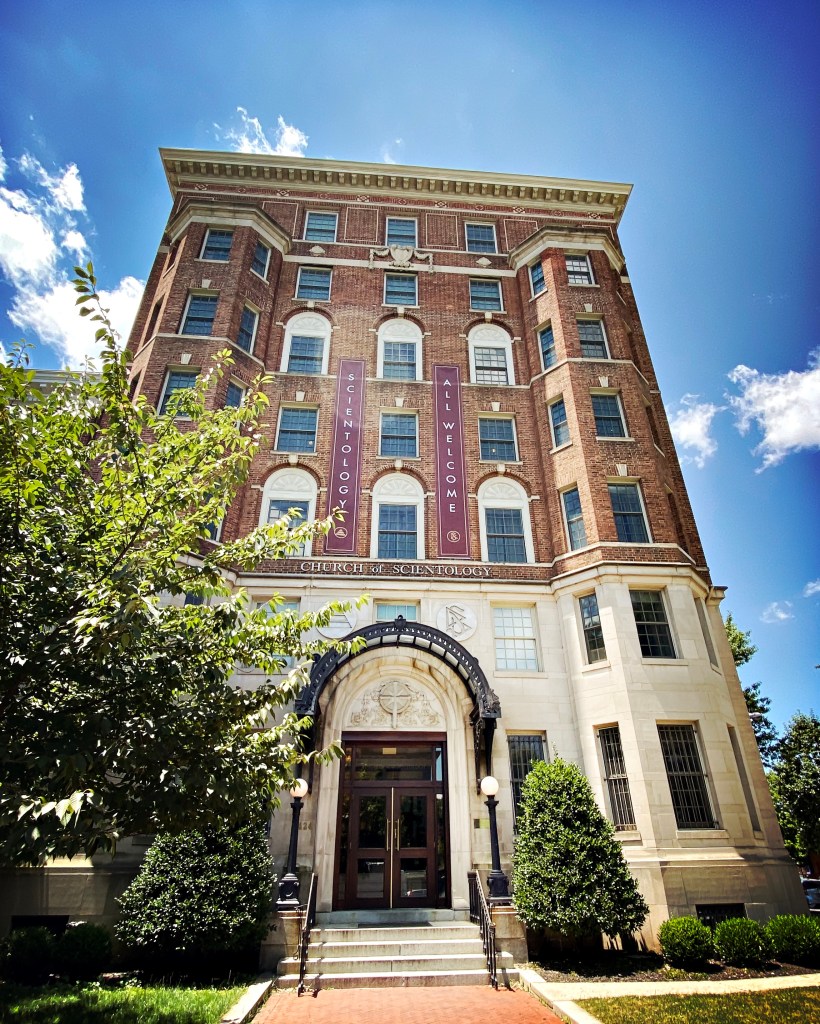
And the Church of Scientology.

Speaking of Scientology, we also passed the L. Ron Hubbard House.

The house was the home of the founder of Scientology from 1955 to 1959 during which time he incorporated the Founding Church of Scientology and performed the first Scientology wedding.

On this beautiful day, with restaurants reopening, there were a number of residents enjoying an outdoor lunch at the restaurants lining 17th and 18th streets. One of the largest and most popular is Lauriol Plaza.

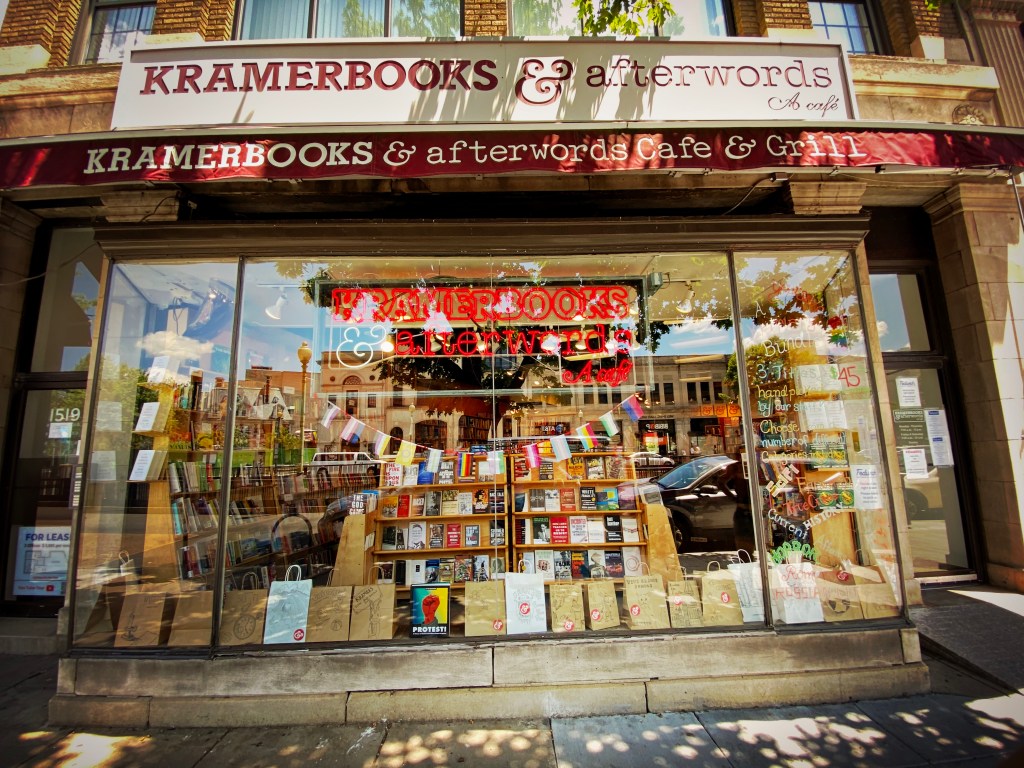
We also passed iconic Kramerbooks, a popular independent bookstore and cafe that, based on a recent newspaper article, may not be at its current location for much longer.

Day 89

Adams Morgan (June 26, 2020)

We started today’s walk in Meridian Hill Park. In many ways it is the quintessential urban park. On the weekends it is an exciting hub, attracting large numbers of local residents who picnic, read, sleep from hammocks hung between the trees, or just enjoy the vibrant atmosphere. Many come to join the large and enthusiastic drum circle that has been taking place in the park on Sunday afternoons for as long as anyone can remember.

The park gets its official name by way of Thomas Jefferson. He believed that the nation’s capital city should set a new American Meridian, a north-south line running through both poles and the American continent. In doing so, Jefferson wanted to reinforce America’s independence from Britain. Surveyors set the new zero degrees Longitude line as running through the White House which is exactly due South of the park.

At a political rally in 1969, activist Angela Davis proposed renaming the park after Malcolm X and it is, indeed, still known by many locals as Malcolm X Park. The park does not include statues of Malcolm X or Angela Davis, but there is a statue of at least one famous activist. A statue of Joan of Arc was gifted by the Ladies of France in Exile to the women of the United States in 1922. It is a bronze copy of an 1889 statue by Paul Dubois that stands at Reims Cathedral in France. In a city full of equestrian statues, it is apparently the only one of a woman on horseback.

The central feature of the park is a 13-basin cascading waterfall. Unfortunately, it always seems to be in need of repair and we can’t recall actually seeing it in use. Hopefully, one day . . .

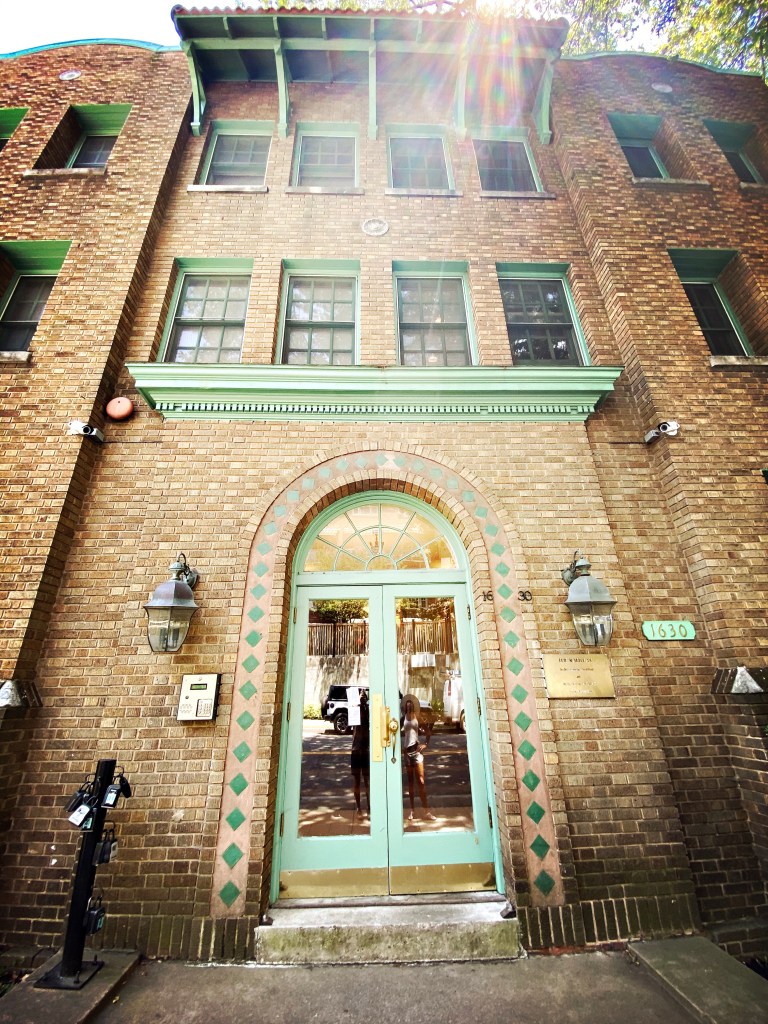
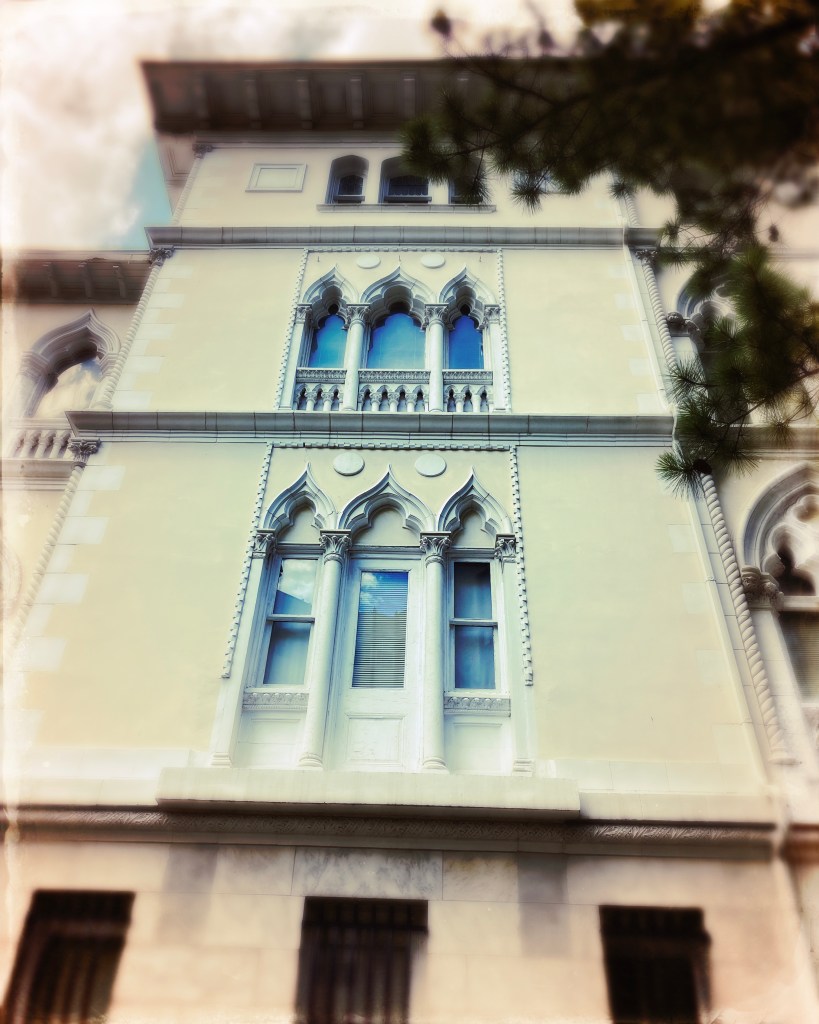
Continuing our walk through Adams Morgan we passed a number of beautiful apartment buildings and townhouses.

We liked this small overgrown apartment building.

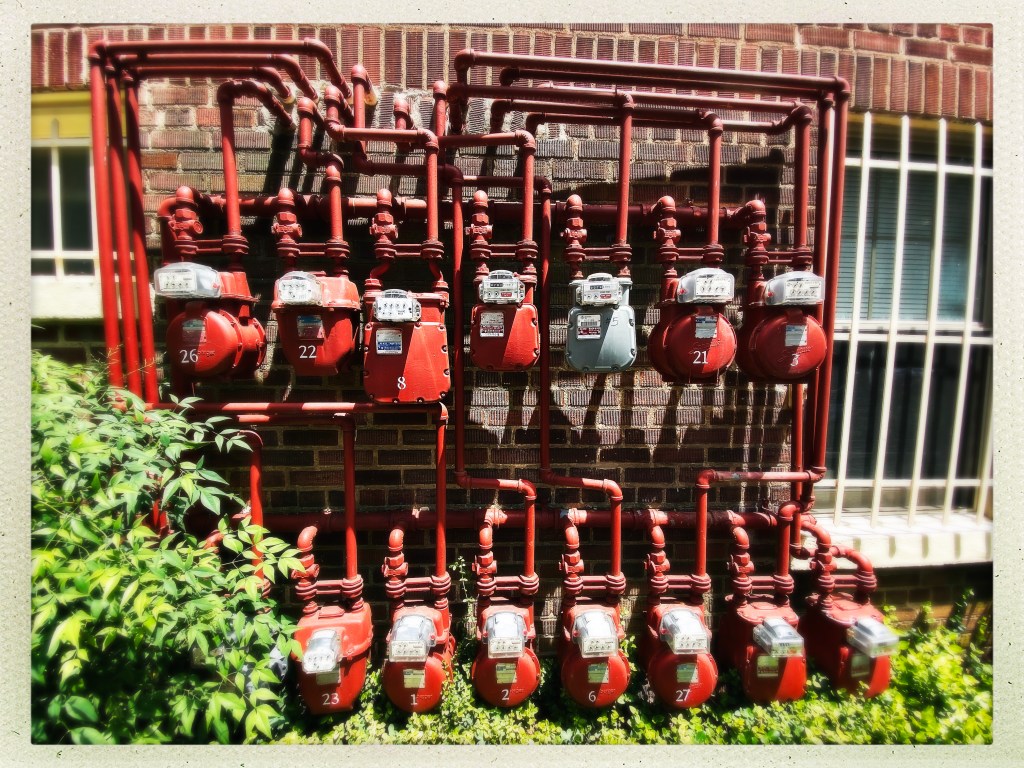
There was something sculptural about the red pipes and meters outside one building.

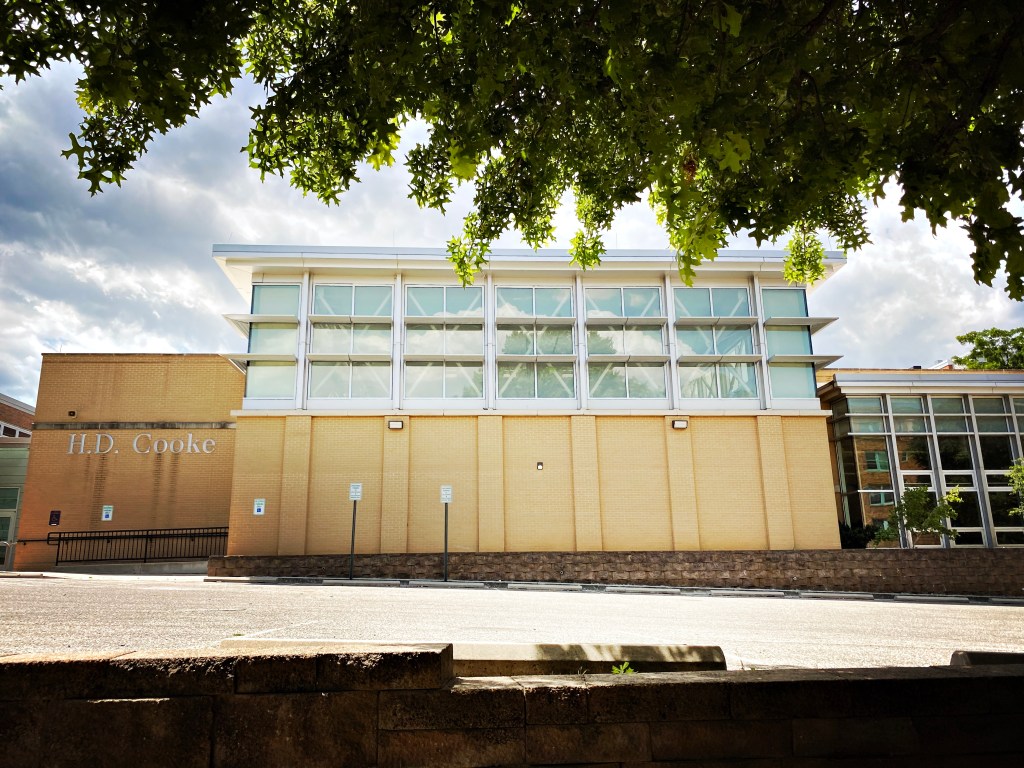
We passed H.D. Cooke elementary school, a District public school serving approximately 400 students.

Old Cooke
New Cooke

One particularly beautiful building we passed was Meridian House which is the headquarters of the Meridian International Center, a non-partisan, non-profit, public diplomacy organization. The house was designed by American architect John Russell Pope and was built in 1920 for Ambassador Irwin Boyle Laughlin. The property was sold to the Meridian International Center in 1960 with a grant from the Ford Foundation.

The most imposing building we walked by was the Scottish Rite Of Freemasonary Temple on 16th Street.